Books
In my books I explore the intersections of sustainability, culture, and our relationship with the natural world. My award-winning books include Renewal, The Heart of Sustainability, Thriving Beyond Sustainability, The Sustainability Revolution, and Tibet: Enduring Spirit, Exploited Land. Through my writing, I invite readers to reimagine sustainability as a living, evolving practice rooted in values, resilience, and care for both people and place.
My forthcoming book, exploring the bridge between nature and us is due to be published in 2027.
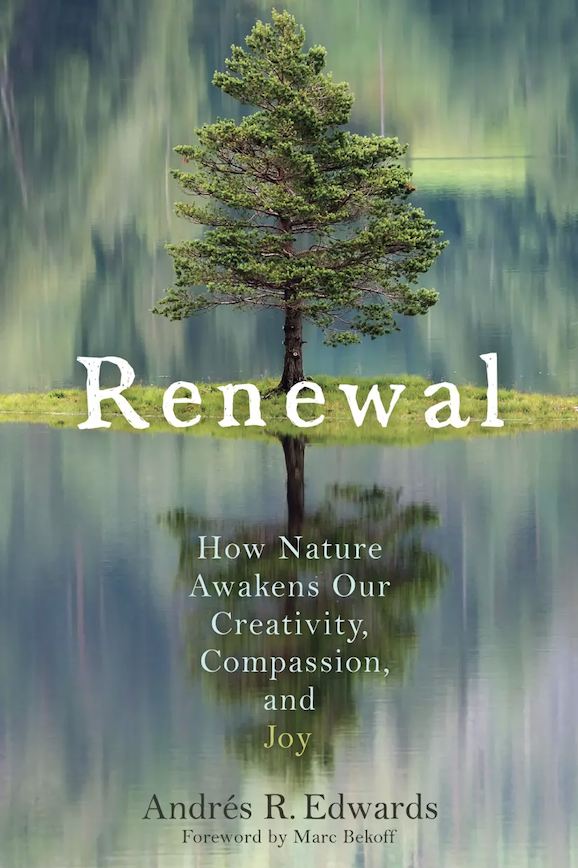

Renewal: How Nature Awakens Our Creativity, Compassion, And Joy
by Andrés R. Edwards, New Society Publishers, 2019
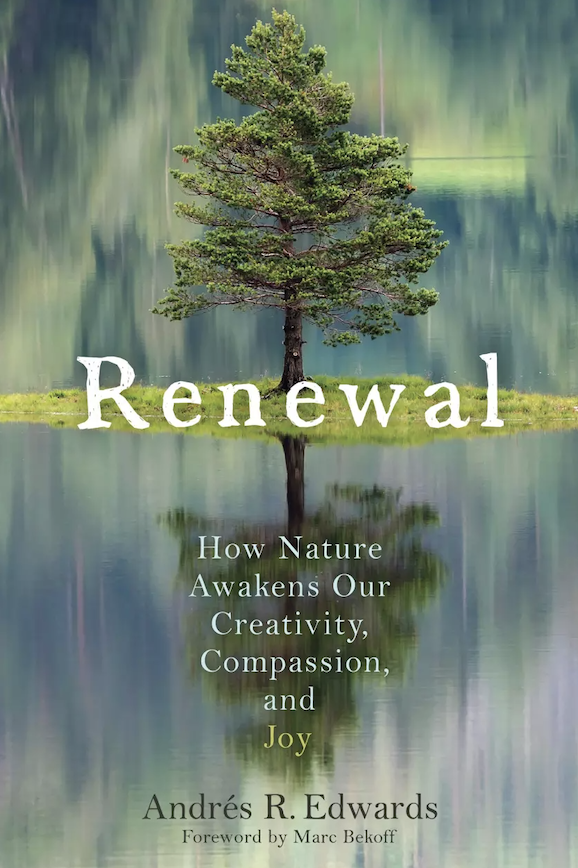
Explore our emotional bond with nature to heal ourselves and the natural world
Why spend countless hours indoors in front of screens when being in nature feels so good? In learning why and how to nurture our emotional connection with nature, we can also regenerate the ecosystems on which we depend for our survival.
Renewal explores the science behind why being in nature makes us feel alive and helps us thrive. Using personal experiences and cutting-edge research in cognitive science, this book weaves delightful stories that:
Reveal nature's genius and impacts on our lives from physical, emotional, intellectual, and spiritual perspectives
Explore how emulating nature is yielding design breakthroughs with biomimicry and biophilic design
Highlight the importance of compassion and coexisting with wildlife in designing our conservation strategies
Describe the significance of nurturing an ecological ethic that supports a reciprocal relationship with nature.
Whether you are drawn to conservation or are interested in the science behind human behavior, Renewal will help create a blueprint for integrating nature with a life of creativity, compassion, and joy.
-
INTRODUCTION: Forging an Emotional Bond with Nature
“We are called to assist the Earth to heal her wounds and in the process heal our own-- indeed to embrace the whole of creation in all its diversity, beauty, and wonder.”
-- Wangari Maathai“While science may lead you to truth, only imagination can lead you to meaning.”
-- C. S. Lewis“We must abandon arrogance and stand in awe. We must recover the sense of the majesty of creation, and the ability to be worshipful in its presence. For I do not doubt that it is only on the condition of humility and reverence before the world that our species will be able to remain in it.”
-- Wendell Berry------------------------------
Evolutionary biologist Stephen Jay Gould declared, “We cannot win this battle to save species and environments without forging an emotional bond between ourselves and nature as well -- for we will not fight to save what we do not love.” [1] As one of the “younger” species inhabiting planet Earth, we humans have embarked on an epic journey to redefine our relationship with the natural world. Our journey begins with the cognitive science breakthroughs that are revealing the impact of nature on our behavior and emotions, and expands outward to encompass a compassionate way of coexisting with nonhuman species and the air, soil, water, minerals and ecological processes that support all life on the planet.
Since we have gradually forgotten the importance of nurturing our emotional bond with nature, we are in a new epoch of remembering. Native peoples such as the Salish from the Pacific Northwest embraced a state of mind where we use our hearts to live by and to help the power, beauty and magic of nature flourish. In more recent times, environmentalist Rachel Carson reminded us that “it is not half so important to know as to feel,” emphasizing the importance of our emotional connection to nature rather than relying solely on our intellect. [2]
Biologist E. O. Wilson expands on our emotional connection to nature through the biophilia hypothesis, which describes our “innately emotional affiliation” to living organisms. [3] And marine biologist Wallace J. Nichols promotes our emotional bond with nature through neuroconservation, focusing on developing a conservation strategy rooted in our neurological responses to nature, especially water. As Nichols points out, “It’s time to drop the old notions of separation between emotion and science .... Emotion is science.” [4] All of these ecological visionaries show how we need to rekindle our feelings about nature and blend our scientific breakthroughs with our emotions.
Recent cognitive studies, aided by technologies such as the CAT scan and the fMRI, have shown numerous physical, behavioral and emotional benefits from being in nature. These include being healthier through reduced stress, blood pressure levels and risk of cancer; and being happier, more compassionate, grateful and creative. But more important than what we take from nature is what we give back.
An ecocentric ethic asks: “What is our responsibility as stewards to give back to the natural world?” One way of giving back is by embracing a compassionate way of living and developing restorative initiatives that help people, other species and the environment to thrive. This is a reciprocal relationship rooted in embracing our interdependence with nature and taking actions that enrich our connection with it. Douglas Christie reminds us that “our ecological commitments, if they are to reach mature and sustainable expression, need to be grounded in a sense of deep reciprocity with the living world.” [5] This reciprocity beckons us to shift away from short-term objectives and quick fixes and instead adopt a long-term, resilient vision for the future -- one in which we play an integral role and take responsibility for its fruitful outcome.
Renewing ourselves and nature also involves a biomimetic approach in which nature is our mentor and teacher. We are already using nature’s 3.8 billion years of experience to learn how to generate abundant renewable energy, grow healthy food crops without depleting the soil and water table, provide safe drinking water, design efficient transportation systems and access to medicines and develop new ways to eliminate waste and pollution and stabilize the climate.
We have much of the knowledge needed to achieve these objectives. Now we need to streamline the social-political systems that act as barriers. We can do this by remembering ourselves as compassionate beings who care for one another and for the environment. Taking care of each other and nature begins by emulating nature’s living systems so that we live in harmony with it. This approach is based on a model not of scarcity but of abundance. It involves recognizing that although we have an important role to play as a dominant species, we depend on nature for our survival. It’s a relationship where we “give” and “take” so that everyone thrives.
Our relationship with nature also benefits when we practice the precautionary principle (“better safe than sorry”). When we consider our responsibility as stewards of the Earth with humility, we gain a broader perspective to make wiser decisions that affect all life on Earth. Many of the planet’s global systems, such as the climate, are impacted by our actions. Following the precautionary principle in implementing a new technology, we take action only after ensuring a safe outcome.
By nurturing our innate curiosity and our affinity for nature we can renew our respect and admiration for the natural world. We are learning, for instance, about the remarkable ability of bees in designing their hexagonal-shaped honeycombs, crows in communicating dangers across generations, caribou herds using swarm intelligence and evading wolves with precise movements and trees that communicate with each other about impending droughts. These examples ignite our passion for nature’s genius. This passion is a recipe for falling in love with and protecting nature. Witnessing nature’s genius stimulates the creativity we need to devise ways to enhance rather than degrade the environment.
The altruism of nonhuman species inspires us to emulate their acts in our families and our communities. Brazilian ant species sacrifice themselves to protect their kin by sealing the colony’s entrance and dying in the cold overnight temperatures; female bats share regurgitated blood to nourish other bats in need; and honey bees fatally rupture their abdomens after using their stinger to protect the hive. These altruistic acts illustrate how nature mirrors the best qualities in the human heart.
Nature can teach us how to live compassionate, creative and joyful lives. Our hearts grow as we remember the importance of loving nature. I hope the stories in this book inspire you to discover how you can make your life and nature thrive by nurturing a reciprocal, enduring relationship with the natural world.
---------------------------
Notes
1. Stephen J. Gould. "Enchanted Evening." Natural History, September 1991, p. 14.
2. Rachel Carson. “Help Your Child to Wonder.” Woman’s Home Companion, July 1956, p. 46. [Cited April 6, 2018]
https://training.fws.gov/History/Documents/carsonwonder.pdf3. Stephen R. Kellert and Edward O. Wilson, eds. The Biophilia Hypothesis. Shearwater, 1995, p. 31.
4. Kevin Zelnio. “A World Ocean.” Scientific American, June 8, 2011. [Cited April 7, 2018]
https://blogs.scientificamerican.com/guest-blog/a-world-ocean/5. Douglas E. Christie. The Blue Sapphire of the Mind: Notes for a Contemplative Ecology. Oxford University Press, 2012, p. xi.
-
CONTENTS
Acknowledgments
Foreword by Marc Bekoff
INTRODUCTION: Forging an Emotional Bond with Nature
CHAPTER 1: Aligning with Nature
Doorways to Nature | Types of Nature Alignment | Internal and External Alignment | Natural Principles | Awareness and Humility | Natural IngredientsCHAPTER 2: Awe and Beauty
Awe’s Qualities | Beauty’s Attributes | Reinstilling Awe and BeautyCHAPTER 3: Health and Well-Being
Healing Impacts of Nature | Nature As a Vital Supplement Green Care | Finding Our Place in NatureCHAPTER 4: Mentor and Provider
Learning from Nature | Cycles and Milestones | Nature As ProviderCHAPTER 5: Nature's Intelligence
Intelligence of Gaia | Why Nature’s Intelligence Matters | Nature’s Designs | Animal Intelligence | Plant Awareness | Slime and MushroomsCHAPTER 6: Kinship and Creativity
Skalalitude | Biophilic Design | Creativity and Nature | Nature As Canvas
Beyond Nature As ResourceCHAPTER 7: Compassion and Coexistence
Cultivating Coexistence | Biological Altruism | Animal Emotions
Compassionate Conservation | Rewilding Our HeartsCHAPTER 8: An Ecocentric Ethic
An Integral Perspective | Five Global Trends | Reciprocity Through Nature
Flourishing with Nature | A Legacy of Regenerative Coexistence | Doing What We CanResources
Bibliography
Notes
IndexAbout the Author
-
Based on years of research about people who were extremely healthy -- self-actualizers -- pioneering psychologist Abraham Maslow found that all self-actualizers develop a love for nature, as nature without and nature within are ultimately the same, and when those two realities harmonize, many good things happen. In these times when less than half of Americans say they participate in outdoor recreation, and mental health problems have become epidemic in part due to people spending too much time watching electronic screens, Andrés' book will help people return to their roots and discover the healing and inspiring powers of nature.
---James A. Swan, PhD, author, Nature as Teacher and HealerAndrés Edwards demonstrates a deft, easy touch in this wonderfully free-roaming book. He writes of developing a sense of awe for the natural world, becoming eco-literate, healing and de-stressing with the help of the outdoors, and pursuing bio-mimicry as a way to develop wiser and more efficient technologies. This inspiring mix of inner work and outer action reminds us we still have a chance to save the planet (and ourselves), if we turn to nature as our guide.
---Mary Reynolds Thompson, author, Embrace Your Inner Wild and Reclaiming the Wild SoulAndrés Edwards’ important new book walks us through the steps of forging a powerful emotional bond with the rest of nature, teaching us how to compassionately and ethically align our individual and collective lives with our age-old, super-intelligent teacher, mentor, healer, guide and most intimate and cosmic kin. Without opening ourselves to Nature's awesome beauty and presence, we cannot survive for long.
---Linda Buzzell, co-editor Ecotherapy: Healing with Nature in MindA key subject, explored with clarity.
---Jeremy Narby, author, Intelligence in NatureFinding our connection to the real, living world is one of the most important things we can and indeed must do. Renewal contains many guiding ideas and suggestions for making the connection a real part of our lives. After you read it, get out there and build your own lifetime of experiences.
---Carl Safina, author, Beyond Words: What Animals Think and FeelSaving nature is not just an altruistic act. In saving nature we also save ourselves since our innate affiliation with it supports our wellbeing. Nature provides services that we can hardly replicate and can be the inspiration for the things we design. Andrés Edwards has articulated the message that our lives are tied economically, intellectually and spiritually to nature.
---Bill Browning, Partner, Terrapin Bright GreenThis book is a pioneering exploration of an epochal (and bitterly necessary) shift in our attitude toward nature. Edwards sees nature not as an external resource to make human life safe but as part of the paradigm of reciprocity that makes our existence possible and allows reality to flourish. Ecosystems are love processes and love is a primary ecological force. These core insights can help us align our civilization with life.
---Andreas Weber, author, Biology of Wonder, Matter & Desire, and EnlivenmentIn Renewal, Andrés Edwards beautifully describes the power of developing a reciprocal relationship with nature that helps us live in harmony with the natural world. This book includes remarkable stories and neuroscience discoveries that inspire us and call on us to connect to nature and live more fulfilling lives.
---Thupten Jinpa, author, A Fearless HeartFrom his stone home overlooking the Pacific, poet Robinson Jeffers wrote: "We must uncenter our minds from ourselves; we must unhumanize our views a little, and become confident as the rock and ocean that we were made from.” Andrés Edwards confidently and elegantly guides us through how to unhumanize, and then rehumanize, ourselves.
--- Wallace J. Nichols, PhD, author, Blue MindRenewal is a journey that takes us home. It vanquishes the illusion of separation responsible for so much of the suffering we are witnessing in the world today to reunite us with what we really are… an integral part of the universe around us. Edwards’ personal love affair with this world and his eclectic relationship with sages from every time and culture make this journey delightful, nourishing, and worth every page.
---Sandy Wiggins, co-founder and principal, Consilience, LLC; Director, Business Alliance for Local Living Economies (BALLE)Rediscovering joy through nature is of critical importance within the climate movement; the bonds that hold movements together aren't just strategic, they build our compassion. This book can be a guide on that journey.
---May Boeve, executive director, 350.orgWe can feel a wide range of emotions in nature, and everyone has their own personal relationship with the outdoors. Using personal anecdotes and scientific evidence, Renewal illuminates the different ways we can emotionally and intellectually connect with nature as well as practical ways we can deepen this relationship to promote both our own flourishing, and that of the natural world around us.
---Craig L. Anderson, PhD, University of California, San FranciscoWhy 30 Minutes of Nature a Day Is So Good For Your Health. Science is showing how immersion in nature speeds healing and acts as an antidote for many ailments. Exerpt from Renewal. Yes Magazine. April 10, 2019.
-
The Roundtable, WAMC Northeast Public Radio Productions, NPR, Albany, NY, National. Interview with Joe Donahue. June 11, 2019 (audio: 10 min.)
15 With The Author, KYMN Radio in Northfield, Minnesota. Interview with Teri Knight. June 10, 2019 (audio: 15 min.)
The Frankie Boyer Lifestyle Show, WBIX/WXBR, Boston and National.Interview with Frankie Boyer. June 5, 2019 (audio 8 min. from 11:09-19:33)
The Idea Exchange, WBEV Radio, Madison and central Wisconsin.Interview with Brenda Murphy. May 31, 2019 (audio: 12 min. from 19:15-31:03)
Thrive with Morella, WBTV Radio, Vermont. Renewal Through Nature.Interview with Morella Devost. (audio: 34 min.)YouTube video of Thrive with Morella, WBTV Radio, Vermont. Renewal Through Nature. May 22, 2019 (video: 30 min.)
Earthworms with host Jean Ponzi, conversations podcasting from KDHX St. Louis Independent Media. Interview with Jean Ponzi. May 15, 2019 (audio: 37 min.)
Ecotopia on KZFR 90.1 Chico, CA. Exploring Ecosystems--Environmental, Social and Technological. Interview with Stephen and Susan Tchudi. May 15, 2019
The Morning Show, Dean & Friends. KMA Radio, KMALand, ABC Radio/Westwood One Affiliate.Interview with Dean Adkins. May 13, 2019. (audio: 9 min.)
The Morning Show, KAXE/KBXE Radio.Interview with Heidi Holtan. Regionally syndicated NPR. May 13, 2019. (audio: 15 min.)
How Nature Awakens Our Creativity, Compassion, and Joy. A new book explores our emotional bonds with nature. By Marc Bekoff. Psychology Today. April 30, 2019.
•Interview with Andres Edwards, author of Renewal: How Nature Awakens Our Creativity, Compassion, and Joy. By Sara, New Society Publishers. April 25, 2019.

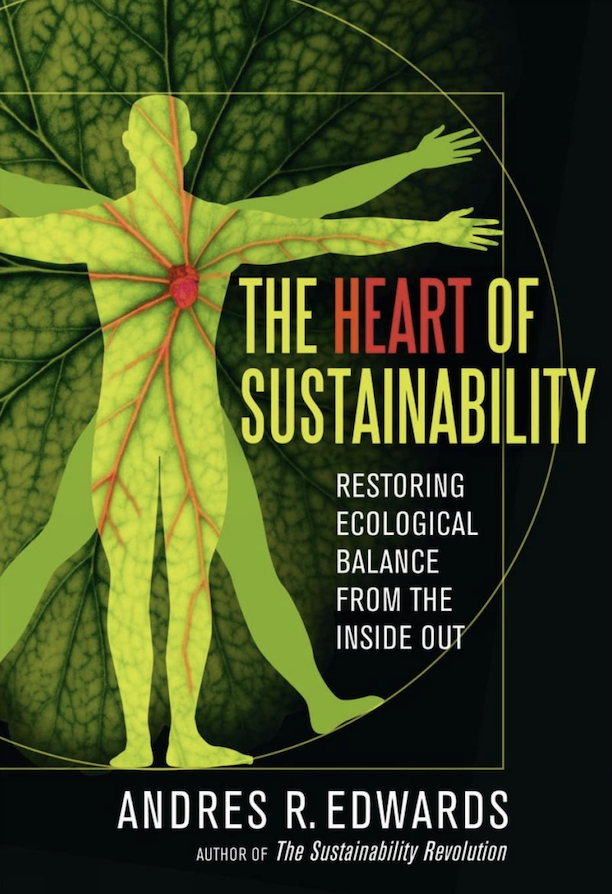
The Heart of Sustainability: Restoring Ecological Balance From the Inside Out
by Andrés R. Edwards, New Society Publishers, 2015
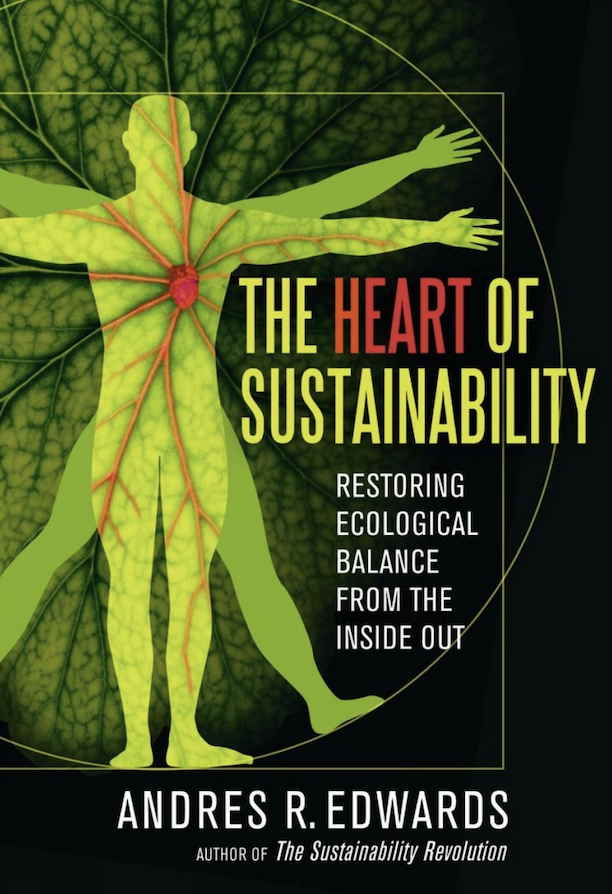
Amidst the doom and gloom that dominates the headlines, a different kind of story is unfolding. The players are activists, visionaries and cultural innovators, the backdrop is the tipping point of our global and environmental challenges, and the narrative is the molding of a new paradigm to shape our collective future.
The Heart of Sustainability delves into the human dimension of this burgeoning international movement to build a better world. Author Andres Edwards frames the conversation about consciousness and sustainability by:
Explaining how self-development is a key driver for planetary change.
Describing how the confluence of the consciousness and technological revolutions provide unique opportunities for balance and fulfillment.
Exploring how we can move forward individually and collectively to create a thriving, livable future from the inside out.
This landmark work illustrates the integration of the four Es: ecology, economy, equity, and education— the bedrock of the current sustainability framework—with the four Cs: conscious, creative, compassionate and connected. Focusing on specific examples and concrete initiatives from around the world, it shows us how to reconnect with ourselves, each other, and nature in order to tackle the challenges we face as a global community.
-
Introduction:
Looking Within to Seed an Enduring Vision for the Future
What’s needed now is neither fatalism nor utopianism, but a suite of practical pathways for families and communities that lead to a real and sustainable renewable future …. We need inspiring examples, engaging stories, and opportunities for learning in depth.
-- Richard HeinbergWe are here to awaken from the illusion of our separateness.
-- Thich Nhat HanhFaith is not about finding meaning in the world, there may be no such thing -- Faith is the belief in our capacity to create meaningful lives.
-- Terry Tempest WilliamsThis book completes an exploration of the three main facets of the sustainability movement. The Sustainability Revolution examined the principles and bedrock values of sustainability, describing the aspiration of the world community to create a life in harmony with the Earth’s living systems. Then Thriving Beyond Sustainability investigated the individuals and organizations implementing these ideas through large and small initiatives in rural villages and urban centers throughout the world. Now The Heart of Sustainability considers the personal aspects of sustainability, with insights into how we can maximize our positive impact on the economic, social, and environmental challenges we face.
Two of the most significant factors shaping our well-being today are the consciousness and the technological revolutions. They affect us individually on a daily basis and call on us to make choices that can either enhance or diminish our well-being. We see the consciousness revolution in the scientific advancements in neuroscience, which have led to a widespread interest in topics ranging from brain research to meditation, mindfulness, positive psychology, yoga, qigong and other martial arts, and awareness exercises. The technological revolution is changing how we check in with ourselves and communicate with our family, friends, colleagues, and the world at large. The expansion of social media though Internet software platforms such as Facebook, Skype, Twitter, Instagram, LinkedIn, and a plethora of other applications, blogs, and email programs has transformed the way we interact. While our ubiquitous devices have made it simple for us to stay “in touch” and share our experiences, this hyperconnectivity has taken its toll on our connection to nature.
At the confluence of the consciousness and technological streams, we stand as individuals attempting to adapt to an increasingly rapid pace of life and make the best choices for ourselves and our loved ones. Three insights may guide us as we navigate the future: (1) we are part of nature, not separate from it; (2) we will benefit from taking a regenerative approach to the challenges we face; and (3) now is the time for us to step up and take leadership roles on behalf of all beings and the planet.
Bridging the separation from the natural world that many of us feel begins by reconnecting to ourselves and to where we live. Mindfulness often yields clarity in our interdependence with all natural systems. By going within, we sense our connection to the web of life, beginning with our backyard.
A regenerative approach builds on our connection to nature by integrating nature’s abundance, resiliency, and adaptability into our perspective of the world. The glass is not half full but is overflowing with possibilities. The mindset is one of abundance rather than scarcity, possibility rather than limits, and embracing the unknown rather than fearing it. Using a regenerative approach allows us to create conditions where the goal is to thrive rather than merely to minimize our negative impact. So our homes are built to produce more renewable energy than they use; we improve the biodiversity of places previously destroyed by development; and we give back to others many times what we have received.
Taking a leadership role means that we look no farther than ourselves to see what is needed and to act. We are the leaders we have been waiting for. Instead of looking for “heroes” to solve the problems we face at the local, national, and global levels, we must look at our own gifts and talents and take the leap to gather our friends and neighbors and take action on issues important to us.
The exponential rate of technological advancement will undoubtedly continue. Indeed, many environmental and social solutions have already emerged. Our challenge lies in reaching our own personal potential to live a life in which we demonstrate our highest selves – first to tap deep within ourselves to discover what we are called to do in our lifetime and then to manifest this calling with the enthusiasm, care, and compassion that are in us, yearning to be shared. For this shift in awareness to occur, we need to be still and listen quietly to what stirs us, as a wildlife photographer stands still and observes the beauty of nature emerging. Subtle light changes during a sunrise, the wing flaps of a dragonfly, the majestic breaching of a whale -- these moments arise sometimes dramatically and other times gradually, but we are able to capture and integrate their essence after opening our hearts to the beauty and awe of life in all its forms.
The journey of discovery in The Heart of Sustainability begins with the significance of our cultural narrative and how we are currently between stories. The old story of dominating nature and turning her resources into material possessions is quickly reaching a dead end. Since the new story of living a balanced, conscious, and compassionate life in harmony with the planet’s living systems has not yet taken root, we find ourselves with only glimpses of the future.
Personal myths, such as “I’m not good enough” and “I’m only one person with limited power,” often stunt the ways we can create meaningful change. These myths emphasize that we are separate from nature rather than an integral part of it; that we are ruled by a scarcity mindset rather than one of abundance; and that fear rather than assurance has become an essential motivating force.
What is necessary for living a fulfilling life in harmony with natural systems? Our well-being is integrated with the well-being of the Earth. A focus on the environmental, economic, and social elements of sustainability is insufficient without an accompanying focus on our own characteristics: our capacity for being conscious of our activities, creative in our endeavors, compassionate toward others, and connected to ourselves and all life forms.
Our current geologic period is described as the Anthropocene -- anthropo, or human, and cene, or epoch. This time in Earth’s history is marked by the tremendous ecological devastation caused by humans and our failure to recognize our interdependence with all life. What we do to the benefit or detriment of other species comes right back to affect our own well-being. Although we are playing a “leading role” in shaping the Anthropocene, we are not the only “actors” on the world’s stage and are continuously co-evolving with other life forms. Perhaps sharing the stage with more grace and humility will allow the flourishing of other species and benefit us all. As Richard Heinberg reminds us, “In the end, the deepest insight of the Anthropocene will probably be a very simple one: we live in a world of millions of interdependent species with which we have co-evolved. We sunder this web of life at our peril. Earth’s story is fascinating, rich in detail, and continually self-revealing. And it’s not all about us.” [1]
What is our role and how do we leave a legacy that will inspire our children and grandchildren and support their well-being and the health of the planet? As biologist Janine Benyus writes, life creates conditions conducive to life. As humans who aspire to reconnect to the web of life, we can turn to nature to help us reconnect to our hearts. We can then move toward understanding the impact of our actions in an interconnected world.
Implementing positive change in the world requires leadership, and there are a variety of leadership styles. Numerous forms of activism complement various temperaments and personalities. Understanding our own strengths and weaknesses helps us see how we may work to inspire others with our passion for reaching a common goal. What motivates us? What will get us to change course? What are the values that will guide us toward the compelling future we all long for?
To answer these questions, we need compassion, openness, understanding, regeneration, action, gratitude, and empathy. The encouraging news is that these qualities are already seeding initiatives worldwide. Now is the time for all of us to join in and help these initiatives grow.
---------------------------
Notes
-
CONTENTS
Acknowledgments
INTRODUCTION: Looking Within to Seed an Enduring Vision for the Future
CHAPTER 1: A New Story
Anatomy of a Story | Our Role in the Hero’s Journey | Living Between Stories Themes of the New Story | Visions of the New StoryCHAPTER 2: Changing the Old Story
From Separate to Aligned with Nature | From Scarcity to Abundance | From Fear to Assurance | Reframing the Ecological CrisisCHAPTER 3: Purpose, Meaning, and Happiness
Quality of Life | Nature and Well-being | Social Ecotones | Gathering in Public Places | Personal and Global HappinessCHAPTER 4: Reconnecting to Ourselves and to Nature
Ecology | Economy | Equity | Education | The External Es and Internal Cs | Consciousness | Creativity | Compassion | ConnectionCHAPTER 5: Leading from the Heart
Leadership Styles | Being of Service | Supporting Positive Qualities Through Conversations | Leading from WithinCHAPTER 6: Activism with Heart
Types of Activists | Mental Models and What Motivates Us | Spiritual Activism | Sacred Activism and Networks of Grace | Giftivism | Activism and Faith CommunitiesCHAPTER 7: Finding and Connecting the Dots
System Shifts | Places to Intervene in a System | The Lisbon Principles | Holistic Education | Conservation Psychology | Ecological Intelligence and Related Quotients | Empathy and NatureCHAPTER 8: Envisioning a Compelling Future
The Future We Want | The Sharing Economy | Future Paths | The COURAGE Framework | Looking WithinResources
Notes
Index
About the Author -
With The Heart of Sustainability Andres Edwards has made the crucial link between the subjective inward quest for consciousness development and the objective outward movement for environmental sustainability. Although the ability to think holistically is a well-recognized attribute of heightened consciousness, the capacity and motivation for action is not normally associated with such consciousness. Edwards shows us, however, that expanded (i.e., non-dual ) consciousness is precisely at the heart of and driving the largest mass movement in human history, the global movement for environmental sustainability.
-- Raz Ingrasci, Chairman of Hoffman Institute InternationalIf we are to successfully address the social and environmental challenges that confront us, we’ll need to bring our complete selves, both head and heart, to the task. Andres Edwards provides a clear and concise guide, showing how each of us — as business people, educators, and concerned citizens — can contribute to fundamental change. This is an indispensable road map to creating a better world.
-- Joel Makower, Chairman and Executive Editor, GreenBiz Group, and author, Strategies for the Green Economy
This book is for anyone experiencing the tension that our culture creates between the way we actually treat our natural world and each other, and the way we, deep in our hearts, know we should. It’s both inspiring and informative, and beautifully written. Well done!
-- Kathleen O'Brien, LEED AP, CSBA, Cascadia Fellow, Executive Director: The EMERGE Leadership Project (ELP)The Heart of Sustainability eloquently delves into the personal journey associated with a life well lived at this moment in history. Andres shows how love and service are essential elements of transformation: for individuals, communities and our planet.
-- Jib Ellison, CEO, Blu SkyeCreating a just and sustainable society will require changing how we live. And, as Andres Edwards passionately argues, that will mean changing how we think, and changing the stories that shape our identities and motives. This is an essential addition to the sustainability literature, tethering environmental policy to our very souls.
-- Richard Heinberg, Senior Fellow, Post Carbon Institute, author, Afterburn and The End of GrowthA compelling compilation of emerging thought, backed by real examples and resources. The Heart of Sustainability focuses on the idea that sustainability can and must go beyond "doing less harm," and beyond the idea that the problem is "them, out there." Instead, Edwards challenges us to look within for solutions - to cultivate the capacity within each of us to create abundance, balance and goodness in the world.
-- Josie Plaut LEED AP BD+C, Associate Director Institute for the Built Environment
Andres Edwards continues his compelling narrative on sustainability in the third book of his trilogy, The Heart of Sustainability, giving insight into how each of us can maximize our positive impact. A tour de force demonstrating how to live a balanced, conscious and compassionate life in the face of an exponential rate of technological advancement. Compelling, thoughtful and inspiring.
-- James R. Doty, M.D., Founder and Director of the Center for Compassion and Altruism Research and Education at Stanford University and author of Into the Magic Shop: A Neurosurgeons Quest to Discover the Mysteries of the Brain and the Secrets of the Heart

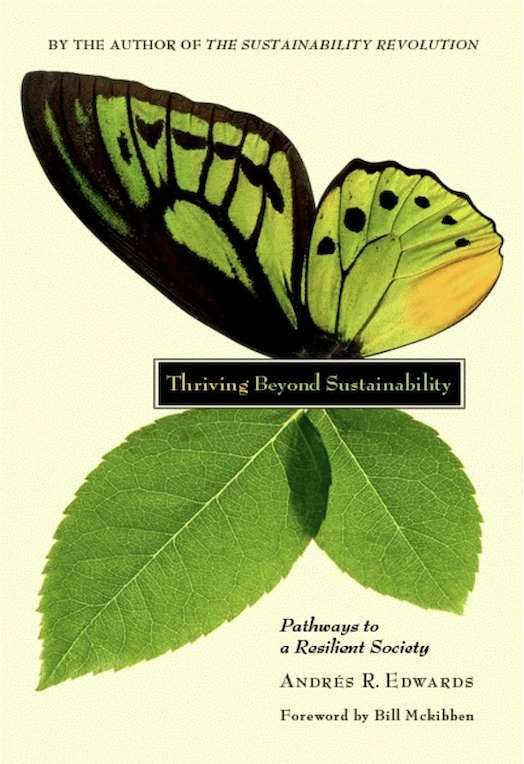
Thriving Beyond Sustainability: Pathways To A Resilient Society
by Andrés R. Edwards, New Society Publishers, 2010
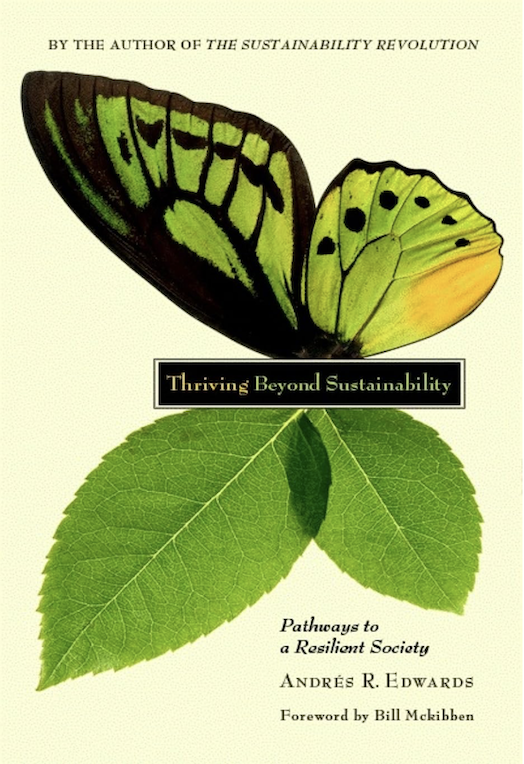
Every 15 seconds on our Earth Island, a child dies from waterborne disease. Three times an hour, another species becomes extinct. Each day we consume 85 million barrels of oil and pump 23 million tons of carbon dioxide into an already warming atmosphere. But against this bleak backdrop, beacons of hope shine from thousands of large and small initiatives taking place everywhere from isolated villages to major urban centers.
Thriving Beyond Sustainability draws a collective map of individuals, organizations and communities from around the world that are committed to building an alternative future — one that strives to restore ecological health, reinvent outmoded institutions and rejuvenate our environmental, social and economic systems. The projects and initiatives profiled are meeting the challenges of the day with optimism, hope and results, leading the way in:
• relocalization
• green commerce
• ecological design
• environmental conservation
• social transformation.
Overflowing with inspiration, the stories and ideas in these pages will cause the most chronic pessimist to see the glass as half full — to move beyond a perception of surviving with scarcity to one of flourishing with abundance. The comprehensive resource section provides the tools for everyone to become a catalyst for change.
-
FOREWORD
by Bill McKibbenI’ve just returned from Denmark, where hopes for a historic worldwide agreement to bring global warming under control went down in, well, flames. The Copenhagen conference was dispiriting in every way—the great powers refused to listen to the small nations, to civil society, to scientists. They signed their own meaningless document—no timetables, no targets—and jetted back to DC and Beijing.
Or rather it was dispiriting in every way but one. In the years since the Kyoto meeting of the late 90s, a huge groundswell has formed across the planet. Every kind of person was on hand—activists, entrepreneurs, people working locally, regionally, in business, in the arts. There’s a critical mass out there—it just hasn’t coalesced yet into something powerful enough to challenge the status quo.
This fine book gives some idea of how that might happen. It offers example after example of what is already working and could be brought to scale. And with its SPIRALS framework and its rhetoric of thrive-ability, it offers some sense of how that scaling-up might happen.
After Copenhagen we’re faced with the fact that our leaders will not solve this problem for us. We’re going to have to do it, one place and one country and one planet at a time. Let’s get to work.-- Bill McKibben
December 2009 -
TABLE OF CONTENTS
Acknowledgments
Introduction: Drawing a Collective Map of Earth Island
Chapter 1: Lessons from Our Ancestors
Cultural Indicators
Tibetan Nomads
Balinese Water Temples
Inuit Traditional Knowledge
The Kogi: Guardians of the Planet
The Value of Traditional Knowledge
The Extinction of Languages
Building Community
Taking ActionChapter 2: Going “Glocal”
Transition Initiatives
Sustainability Street
Salmon Nation
Regional Climate Plans
National Initiatives: Sweden and New Zealand
International Environmental Plans
Glocalization Reframed
Taking ActionChapter 3: Greening Commerce
The New Bottom Lines
The Drivers
Implementing Nature’s Strategies
The Trilogy
Growth, Consumption and Pollution
Creating New Alliances
Mission-Based Enterprises
A New Role for Civil Society
Blue Chip Companies Turn Green
Tax Shifting
Providing Tools and Metrics
Building New Business Models
Taking ActionChapter 4: Regenerative Design
New Design Approaches and Objectives
Design Tools and Frameworks
Building Green Homes, Towns and Cities
BedZED
Greensburg
Växjö
Integrating Design and Living Systems
Taking ActionChapter 5: Saving Ecosystems
Continental Conservation
Species Protection
Protecting the Land
Conservation Philanthropy
What is Nature Worth?
Conservation Finance
Markets and Nature
Taking ActionChapter 6: Navigating the Confluence
Ecosystem Decline
Energy Transition
Population Growth
Economic Disparity
Climate Change
A Confluence of Possibilities
Taking ActionChapter 7: Catalysts for ChangeGreening Campuses
The Food Revolution
The Green Economy
Mainstreaming Green
Open Source
Initiatives, Confluence, Scope and Approach
Tipping Point Factors
Taking ActionChapter 8: A Thriveable FutureThe SPIRALS Framework
Scalable
Place-making
Intergenerational
Resilient
Accessible
Life-affirming
Self-care
Moving Toward Thriveability
Taking ActionResources
Organizations
Online Publications
Annotated Bibliography
Notes
Index -
Reviews and Endorsements
From sustainability to resilience is the theme of Andres Edwards's new book . . . it is an inventory of grounded hope, practical inspiration, and achievable visions . . . exactly the kind of thinking, work, and doing that will bring civilization to safe harbor.
-- David W. Orr, Author, Down to the Wire
Andrés Edwards has given us a comprehensive, up-to-date, and highly inspiring guide to the pioneering initiatives and practices of individuals, organizations, and communities from around the world who strive to create a future that is ecologically sustainable and socially just. With countless lively examples, the author shows how impressive progress is being made along many different paths, which are about to coalesce into a powerful force for change. The book takes into account the overwhelming scientific evidence of the systemic interconnectedness of the world's major problems, as well as the ecological literacy of time-honored indigenous wisdom. It is thoroughly researched, deeply contemplated, and yet eminently practical. I warmly recommend it to anyone concerned about the future of human civilization.
-- Fritjof Capra, Author, The Web of Life and The Hidden Connections
Edwards covers a breathtaking swath of world-changing stories, frameworks and tools that are essential knowledge for the sustainability advocate. You can't help but feel optimistic after reading this book.
-- Adam Werbach, Global CEO, Saatchi & Saatchi S
Thriving Beyond Sustainability is simply a must-read. It offers a concise, insightful and deeply thoughtful overview of the most hopeful and important emergent trends and ideas driving the global sustainability movement. You will also find an eminently readable book that has shelf life. Edwards is sophisticated, and his nuanced analysis and discernment could not be more timely as green goes mainstream and everyone wants to know: What do we do?
-- Kenny Ausubel, Co-CEO and Founder of Bioneers
Andrés Edwards is a walking database of information on efforts to create sustainable societies, and his enthusiasm for the promise of sustainability is infectious. Read Thriving Beyond Sustainability and your belief in the prospects for human survival--no, human "thriveability"--will brighten dramatically!
-- Gary Gardner, Senior Researcher, Worldwatch Institute
Peppered with examples, Thriving Beyond Sustainability presents a delectable feast of people, communities, companies, and countries thriving by reducing energy and water use, waste, and cost."
-- David Blockstein, Senior Scientist National Council for Science and the Environment
For those of you who have given up, who believe that making environmental change is too hard or too late, this book is not for you. For those ready to be inspired and energized, read this book right away. Edwards’s latest book is chock-full of examples of real solutions, advanced by real people all over the globe – solutions that can build a lasting path towards sustainability.
-- Annie Leonard, The Story of Stuff
Thriving Beyond Sustainability challenges us to move from using a deficit model for thinking about sustainability to using a natural and human abundance approach to thinking about how society will thrive. Edwards provides the reader with both principles and examples from throughout the world. He gives concrete suggestions for action and provides an annotated resource list that supports taking actions. This is a welcome addition to the growing sustainability literature.
-- Paul Rowland, Ph.D., Executive Director, Association for the Advancement of Sustainability in Higher Education
Thriving Beyond Sustainability captures the spirit of the people and organizations finding solutions that are creating a brighter future for all. In this important book, Edwards presents engaging stories about the positive impact that leaders are making in transforming their communities through green building, energy, agriculture and green business practices among others. A fabulous resource for those interested in learning about the challenges and opportunities before us.
-- David Johnston, Author, Toward a Zero Energy Home and Green RemodelingINSPIRING SOLUTIONS
At last, a holistic picture of a transformed way of living on the earth! Not just living, but "thriving."
The book ties together stories about initiatives now underway to transform "five interrelated global trends: ecosystem decline, energy transition, population growth, economic disparity,and climate change."
These stories draw a collective picture of new ways of doing things to restore our personal and cultural health and rejuvenate the ecosystem. Thriving Beyond Sustainability gives examples of the outer situation we find ourselves in along with the resources - outer and inner - we have to bring about new possibilities. Edwards encourages the shift from "sustaining" to "thriving" as a challenge to expand our imagination and focus on the capacity of the human spirit to collaborate in creating meaningful changes that improve the lives of all species.
Thrivability thus becomes a new code word for recognizing the human "capacity for empathy, compassion, collaboration, playfulness, creativity, enthusiasm and love." This seems an easy shift to make, and cuts through ideas that separate classes, races, nationalities, and religions. Once we acknowledge that humans are innately cooperative and seek to thrive, competition and scarcity become outdated concepts and we see how the "examples" can become the mainstream. I fully embrace this book.
-- Kristin A. Pauly, Annapolis, MDFinally a book that doesn’t waste chapters documenting the problems. This book pulls together a lot of the solutions already underway. Chapters include learning from our ancestors, going ‘glocal’, greening commerce, regenerative design, etc. The up-side is that this book pulls together a bunch of good initiatives; the down-side is that if you’ve been in the industry for a while, only dribs and drabs will be new to you. The last chapter lays out his SPIRALS framework, a set of criteria for what he calls a ‘thriveable future’: scaleable, place-making, intergenerational, resilient, accessible, life-affirming, self-care.
-- International Society of Sustainability ProfessionalsThere are plenty of books detailing the dire condition of our relationship with the environment; rather than focus on the many problems surrounding sustainability, Andres Edwards focuses on turning challenges into opportunity in this slim and useful guide. As he identifies a number of successful projects and ideas from around the world, Edwards covers commerce, green design and ultra-local sustainability efforts. At the end of each chapter, Edwards presents concise, bullet-pointed steps for taking action, useful for everyone from the individual hoping to cut his carbon footprint to the serious activist. Add this to pages and pages of links to local, national and international resource groups, and you have one of the more practical and positive sustainability tools available.
-- Next American City (americancity.org)
In his new book, Thriving Beyond Sustainability: Pathways to a Resilient Society (2010), Andres Edwards moves well beyond his initial and seminal description of the cultural paradigm change suggested by The Sustainability Revolution (2005) to a much broader and encompassing vision of how the sustainability movement is gaining momentum and credibility. Based on his initial premise that these shifts were already well underway in fields as diverse as economics, environmental consciousness, and social justice (equity)—the 3 “E’s” of sustainability—Edwards has gone on to ground these in real changes taking place in many segments of our society. In the earlier work, he documented in detail many of the formalized gatherings and proposals for creating a sustainable presence on our home world. In this new work, he has created a collective map to show how individuals, organizations, and communities are collaborating to restore ecological health, reinvent outmoded institutions, and revive our social, environmental, and economic systems.
This latest work is the result of many further explorations, interviews, and solicitations from those leading the charge into a future of hope and possibility. Beginning with an exploration of the influence and teachings of indigenous cultures on our present society, Edwards focuses on what will make our Earth Island survivable for future generations. There are many examples of cultures and societies who have failed to make this leap into the future. In this book the author places his attention on those traditional societies that have successfully persisted over time and contributed insights that are valuable to modern efforts at sustainability. He then moves beyond this grounding in our roots to examine initiatives across the globe that are striving to become more self-reliant in energy conservation, food production, and local services. It is a natural step from there to look at the greening of commerce in ways that reduce environmental impact and mirror the cycles of natural systems. This is a much larger endeavor that extends to green building practices, eco-communities, and the design of functional living systems that reflect nature and allow our citizens to live in greater comfort and security.
Edwards then moves on to examine worldwide efforts to restore ecosystems in decline and protect biodiversity. He identifies five interrelated global trends that command our attention: ecosystem decline, energy transition, population growth, economic disparity, and climate change. In his view, all these conditions are converging and present both great challenge and great opportunity. This provocative treatise explores each of these in turn and suggests courses that might be followed to convert potential dissolution of our existing social and economic systems to great possibilities for creating a new future based on principles that are being tried and tested in a variety of circumstances. He suggests a new set of strategies which he calls SPIRALS involving initiatives that are: Scalable, Place-making, Intergenerational, Resilient, Accessible, Life-affirming, and Self-care. The content of this volume explores these characteristics in detail under the context of striving for Thriveability and not just sustainability. It will take a concerted effort and commitment to move to this new stage of human and social development, but it is a path open to our exploration.
This new concept, thriveability, focuses on a vision of collaboration and abundance where, instead of seeing ourselves separate from nature, we become an integral part of natural systems and embody qualities such as empathy, compassion, and creativity to guide our actions within the human community. This entails a capacity for belief in the human spirit to create new systems of prosperity and peace. We must begin, he suggests, by healing and greening our own lives and then reaching out to the larger community. In each chapter in this book, Edwards suggests strategies to bring about this reality and specific actions in which each of us can be engaged. This is a beautifully written and eloquent plea for us to wake up to our potential and begin to exercise our natural talents for survival. An extensive resource list at the end provides a wealth of references for further research. This volume is written in a spirit of hope and promise that, if we are willing to follow a fairly simple and direct path, we indeed can have a viable future.
-- Rick Medrich, co-founder and chair of PhD program in Sustainability Education at Precott College, Prescott, AZ.
The more research you do into the subject of sustainability, the more you realize that talking about sustainability is like talking about matter. It's so wide-ranging, multifaceted and pervasive a topic that it's hard even to know where to begin. "Sustainable development" is often equated with environmental protection and conservation, but it's actually far broader than that, encompassing economic, political and sociocultural concerns as well. Defined simply as "development that meets the needs of the present without compromising the ability of future generations to meet their own needs,"* sustainable development is more a general approach than a specific set of practices or policies. And it can be applied across literally all sectors of human endeavor, from education to enterprise—and from fine arts to the physical sciences.
Given what a sweeping category sustainability is, author and noted sustainability expert Andrés Edwards is to be commended for distilling it down into two easily digestible volumes for lay readers: The Sustainability Revolution and Thriving Beyond Sustainability. The first book, released in 2005 by New Society Publishers and subtitled as a "Portrait of a Paradigm Shift," showed how large numbers of individuals and organizations across the world had come to recognize the failings of the industrial "growth" economy fast undermining its own ecological foundations, and had begun to forge pathways toward a sustainable future. Their grassroots efforts, Edwards predicted, would prove to be vital guideposts along the uncertain course ahead for humanity. This first book was mostly a theory study; Edwards recalls that he didn't get a chance to flesh out its concepts with tangible examples to the extent that he would have liked. Hence the need for this new book (also from New Society), which he says is intended to share "the stories of the people and organizations undertaking this important work."**
The method of Thriving Beyond Sustainability is straightforwardness itself: the book simply gathers together pointed examples of several key themes long at the core of the global sustainability conversation. The first chapter, titled "Lessons from Our Ancestors," reminds us of Pulitzer Prize-winning author Jared Diamond's case, articulated in his bestselling book Collapse, that human civilizations often decline largely as a result of having despoiled the natural capital on which they depend. Edwards poignantly demonstrates how the modern developed world stands to learn as much from the ancient inhabitants of Easter Island, who went into steep decline after they over-harvested their trees and marine life, as it does from the Inuit, who have managed to thrive for centuries in the Earth's North Polar regions. Some other notable chapters include those on regenerative design, saving ecosystems, going "glocal" and the evolution of the corporate world's new "triple bottom line"—which requires that companies heed social and ecological concerns in addition to economic imperatives when making decisions.
In a vision that will please technological optimists but will seem like blatant pie in the sky to the more pessimistic among the environmental crowd, Edwards insists that with the right approach industrial society can attain a state not only of sustainability, but of "thriveability." Edwards never gives a clear-cut definition of thriveability but he does eloquently describe how it differs from sustainability. "Sustainability," he writes, "separates us from nature and envisions us 'getting by' by limiting our negative environmental impacts over the long term." Thriveability, in contrast, represents a "shift from 'less bad' solutions to solutions that energize us and improve our quality of life through our connections with all life forms."
Edwards asserts that if we citizens of the developed world are to successfully meet our biggest challenges as a civilization (which he deems to be ecosystem decline, energy transition, population growth, economic disparity and climate change), then we must drastically change our entire worldview so that it reflects a thriveability perspective. He says that before beginning any new sustainability initiative we must first evaluate the extent to which it is "Scalable, Place-making, International, Resilient, Accessible, [and] Life-affirming," as well as whether or not it promotes "Self-care" (these criteria go by the acronym SPIRALS). We must also follow the precautionary principle, which states that if there is any doubt as to a proposed initiative's potential risks, we must err on the side of caution and forego implementing it until we have better information.
In the chapters that follow, Edwards presents a thorough analysis of how individuals, corporations, national and regional governments, nonprofits and international organizations, among countless others, are currently undertaking projects that espouse SPIRALS ideals. For example, he highlights the City Repair Project in Portland, Oregon, as an exemplary model of the place-making dimension of SPIRALS. The project aims to transform intersections into lively public squares dubbed "Share-It Squares," which foster community and help reclaim public spaces. Edwards points out that crime rates in these repaired sections of the city fell by 10 percent following their conversion into public squares, as reported in the Journal of Public Health. And he cites the environmentally responsible forestry practices of lumber company Menominee Tribal Enterprises (MTE) as a prime example of SPIRALS' intergenerational component. MTE embraces the "seventh generation" thinking of traditional Native American ethics, which requires that today's decisions be made with a view toward how they might affect people living seven generations from now. Under this directive, the Menominee Forest's total timber volume has not dwindled but rather has steadily grown from 1.3 billion to more than 1.7 billion board feet over the past century and a half.
Where Edwards' analysis falls short, however, is in attempting to illustrate the scalable and accessible aspects of the SPIRALS framework. Compared to the others, these two sections seem overly brief and light on specific examples. For instance, Edwards provides only one concrete example of a present or emerging initiative demonstrating the scalability part of SPIRALS. And that one example, a nationwide infrastructure for electric vehicles (EVs) as envisioned by the EV service provider Better Place, is patently of dubious scalability, as anyone can tell you who has bothered to look into the daunting obstacles that impede wide-scale EV adoption. Further, Edwards sometimes seems to be hammering an example into a particular subset of the SPIRALS framework, when in fact it could just as easily fit into a completely different one, or even multiple subsets.
But these are relatively minor flaws in what is, for the most part, a comprehensive, prodigiously studied panorama of today's sustainability landscape. Drawing on its author's considerable knowledge of ecological design, sustainable business, environmental education and community development projects, Thriving Beyond Sustainability is sure to be one of the authoritative desk references on sustainability for some time to come.
The World Commission on Environment and Development, Our Common Future (Oxford and New York: Oxford University Press, 1987), 43.
* Andrés R. Edwards, Thriving Beyond Sustainability: Pathways to a Resilient Society (Gabriola Island, BC, Canada: New Society Publishers, 2010), ix.-- Frank Kaminski is a member of Seattle Peak Oil Awareness (SPOA), a connoisseur of post-oil novels and a regular book reviewer for Energy Buletin.
In this new book from New Society Publishers, Andres Edwards attempts to push the envelope on how we should not only view the issue of sustainability, but think about our relationship with the natural world. The author begins his analysis by looking at examples of how indigenous cultures around the world have developed a vision/ethic about how to live with nature instead of trying to control it. However, when it came to concrete strategies I felt that the author was too limited and tended to mimic much of the current liberal writing on sustainability.
-- Jeff Smith, GRIID (Grand Rapids Institute for Information Democracy).
I can’t decide how I feel about this book, which discusses “five interrelated global trends: ecosystem decline, energy transition, population growth, economic disparity and climate change.” Is it a comprehensive, clear assessment of the many opportunities we face to convert the current crisis into a much better future for all living beings?
Or is this book naively optimistic about the likelihood of reversing the current course of human events, which is leading to the wide scale destruction of our environment and, therefore, of human civilization?
Much as I like the optimistic tone and can-do attitude of the book, it fails to address the major disconnect between the critical environmental problems we face (global warming, peak oil, depletion of water resources, loss of biodiversity, etc) and the lack of public and political will to tackle these problems in a meaningful way. For example, a majority of the American public no longer believes that global warming is a serious problem. The U.S. Senate, likely reflecting that public view, refuses to adopt any substantive policy to reduce U.S. emissions of greenhouse gases. At least in the United States, most people focus on private property rights, the individual (rather than the community,) and short-term economic gains. Ecosystem services (e.g., clean air and water and good soil) are considered free and abundant. China and India, although quite different from the U.S., also show great challenges in tackling these issues.
Although not addressed directly, the book raises important questions about how each of us can best spend our time and money on these major environmental issues. Should we focus on local, regional, national, or international solutions? Should we make changes in our own lives, work through nonprofit organizations, or seek political change?
As an example, if a benevolent philanthropist gives you $5,000 a year and asks you to spend that money to improve environmental quality, what would you do? Would you buy a more efficient car, get a new bicycle, and install storm windows and more attic insulation in your house? Or would you donate the money to an environmental organization? If you choose the second option, would you give the money to a local, regional, national, or international group? What other options for spending the $5,000 might you consider? Unfortunately, this book does not address these choices.
For me, the key issue is how to convince the majority of Americans that these are important problems we must address now. Too many people believe (1) the economy is what matters, and (2) the environment must take a back seat to our efforts to improve short-term economic performance. How can we demonstrate to them that the economy is part of the larger environment and cannot, in the long run, succeed without a healthy biosphere?
Nevertheless, this is a comprehensive, well written, and interesting guide to a broad range of activities and groups that are addressing today’s environmental challenges. To be practical, each of the eight chapters ends with a “Taking Action” list that suggests several modest and major steps readers can consider for adoption. Examples include:
- Learn about the cultural history of your home region.
- Join your local Chamber of Commerce and suggest ways to promote sustainability initiatives.
- Invite colleagues to a brown-bag lunch and discuss green initiatives for your workplace.
- Research and purchase green building materials for home improvement projects.
- Join a local, national or international environmental group. Participate in one of their campaigns.
- Design a website, blog or wiki that highlights sustainability events of projects in your community and welcomes public input.
- Support your local farmers market. If you don’t have one, start one.
- Develop a green jobs training/internship program with businesses from your community.
This small sample suggests the range and diversity of ways that individuals, acting alone and in groups, can affect positive change. It also shows how challenging and complicated these actions can be.-- Eric Hirst, NW Citizen, Pacific Northwest Politics.
"We face an unprecedented crisis - and a unique opportunity for a brighter future", writes educator, LEED® Accredited Professional, and founder and president of EduTracks, Andrés R. Edwards in his inspirational and world changing book Thriving Beyond Sustainability: Pathways to a Resilient Society. The author describes the environmental challenges facing everyone on the planet and offers alternatives to simply relying on sustainability, but moving ahead to a thriving global green culture.
Andrés R. Edwards recognizes the danger that continuing humanity's current path poses if there are not changes in the way that people, business, communities, and nations care for the environment. The author shares lessons learned from a myriad of sources, ranging from indigenous people, to local initiatives, to the greening of commerce in businesses of all types and sizes. The alternatives presented by the author are based on hope, optimism for the future, and the actions of real people from all walks of life. Andrés R. Edwards exhorts people to change their perception of a world not based on scarcity, or even of sustainability, but one of abundant opportunity for all people to live well and in tune with the natural world. The author asks people to expand their thinking, and to free their minds, to examine and consider fresh and unique opportunities for what he calls thriveability.
Andrés R. Edwards offers ideas for living from traditional people to examples of conservation projects on a world wide scale. Through initiatives that purchase and protect sensitive and delicate areas of unique and rich biodiversity, individuals, community groups and corporations are demonstrating leadership in environmental stewardship. The challenges to the environment are being met with projects both small and large. Instead of accepting the lesser of evils, or the less bad option, the author shows that there is another path to follow. That route is one of thriveability, where actions are encouraged that both rebuild and restore natural ecosystems, but also enrich the quality of life for everyone. Through collaboration, creativity, and compassion, Andrés R. Edwards believes that despite seeming insurmountable adversity, people can overcome the obstacles and achieve a lasting and thriving legacy for future generations.
For me, the power of the book is how Andrés R. Edwards provides a positive message of hope and optimism for the future of our planet. The author combines theory with examples of real people, groups, and companies providing imaginative solutions to what were seen as impossible environmental problems. The author combines these features with practical advice and methods that anyone can utilize on their own, within their community, or as part of business of any size or industry.
The message of respect for the environment, its limitations, and its possibilities moves the idea of ecological thinking beyond that of sustainability. That concept, at best perceives the world as having scarcity and loss. In its place Andrés R. Edwards presents a vision of abundance, prosperity for all, and a renewed relationship with the natural world. Through cooperation, sharing of ideas, and empathy with people and the world, the author points the way to a brighter future, and not one of environmental disaster and destruction. This positive assessment, of the future of the world and its people, achieves the author's goal of changing the way people see and perceive the world around them.
I highly recommend the visionary and yet very practical book Thriving Beyond Sustainability: Pathways to a Resilient Society by Andrés R. Edwards, to anyone seeking an alternative future for our world, its environment, and for all of its inhabitants. In place of doom and gloom, and the feeling of helplessness so often associated with environmental challenges, this book empowers people to take positive action to make the world a better place for the present and the future.
Read the important and perception changing book Thriving Beyond Sustainability: Pathways to a Resilient Society by Andrés R. Edwards, and discover the road map that leads to thriveability instead of the loss of our natural world. This book takes people beyond the false trails of scarcity, and even of sustainability, to the brighter tomorrow through thriveability.
-- Wayne Hurlbert, Blog Business World.
The book contains the following chapters “Lessons from Our Ancestors”, “Going ‘Glocal’”, “Greening Commerce”, “Regenerative Design”, “Saving Ecosystems”, “Navigating the Confluence”, “Catalysts for Change”, and “A Thriveable Future”. Edwards starts by looking at cases of sustainable development starting with Easter Island and comparing it to modern day Samso in Denmark, an island of similar size. Drawing on Jared Diamond’s Collapse (reviewed here), it includes numerous examples of what organizations and companies are doing to “green” their practices.
It is not entirely clear what “thriving beyond sustainability” entails until the final chapter. There are brief mentions of Cradle to Cradle design and regenerative economies scattered throughout the book. Edwards mentions “thriveability” often, suggesting that sustainability measures will allow and ultimately enable groups to be successful moving forward. In chapter eight (“A Thriveable Future”), Edwards provides a framework (SPIRALS) for thinking about moving beyond sustainability, which he defines as Scalable, Place-making, Intergenerational, Resilient, Accessible, Life-affirming, Self-care. SPIRALS is a way to think about creating a future that is healthy and prosperous for generations to come.
Each chapter provides a list of suggestions at the end as to what the reader can do to make an impact. In addition, at the end of the book, there are a wealth of resources on the web that one can use to learn how to reduce their ecological impact and help improve the social systems in which we live and work. Some of the more promising anecdotes from the book revolve around small business owners in the West and the steps they have taken on the social and environmental front, while growing their business’ valuation. Muhammad Yunus’ microloans and payment for environmental services are two of the programs in the developing world that seem to have a major impact in reducing poverty and maintaining ecological systems.
Reading Thriving Beyond Sustainability feels like reading a compilation of posts from 2nd Green Revolution. Many of the companies and individuals mentioned in posts over our nearly two year existence are profiled in this comprehensive look at we have been referring to as the second green revolution.
-- Eric Wilson, Second Green Revolution.
In a time when we are witnessing catastrophic storms, tragic violence and nations in upheaval, riving Beyond Sustainability: Pathways to a Resilient Society by Andres R. Edwards off ers a refreshing and optimistic perspective.
Edwards presents us with a view of our world, our Earth Island, where we bear witness to five interrelated global trends: ecosystem decline, energy transition, population growth, economic disparity, and climate change. Edwards points out that with the convergence of these challenges “we face an unprecedented crisis – and a unique opportunity for a brighter future.”The journey to redefine our relationship with the natural world begins as all journeys do – with our ancestors. Traditional cultures the world over have demonstrated their ability to adapt and survive by way of understanding the interrelationships within an ecosystem, while recognizing humans as part of that system. This traditional ecological knowledge, postulates Edwards, can complement technological advances. But as we lose indigenous cultures, we also lose crucial knowledge for living in balance with the natural world.
Edwards cites projects from around the globe that simultaneously benefit impoverished populations, individual species, and entire ecosystems. When speaking to the critical issue of safeguarding ecosystems, Edwards makes the case that we must evolve beyond the focus on preservation to a strategy that balances ecological protection with the economic and social needs of people. Only with the support and commitment at the local level can longterm success be recognized.
Edwards also addresses our current economic crisis in relation to the ecological crises we face. He illuminates the fact that there is not enough energy or raw materials to support the world’s economic growth at its current rate, and if the world’s population carried a standard of living we are aff orded in the U.S., we’d need three to five Earths to support it. Edwards argues that “recalibrating our economic system so that it more accurately reflects the true costs of resource extraction” is key to safeguarding our limited resources for future generations.
Another solution is designing our human habitat with a more holistic approach. Smart Growth, New Urbanism, and regenerative design are a few strategies highlighted. Edwards points to places like Greensburg, Kansas and Växjö, Sweden, whose residents are redefining the interface between people, buildings, and nature by encouraging development based on natural cycles and cultural traditions.
Edwards brings the book to a close by challenging us to shift from a mindset of sustaining – or getting by – to thriving, enriching the world, and celebrating abundance. He states, “When we are attuned to the rhythms of nature, the possibilities are infinite. This shift from ‘less bad’ solutions to solutions that energize us and improve our quality of life through our connections with all life forms is the essence of thriveability.”-- Dan Ehresman, Healthy Humboldt. The Northcoast Environmental Center
The title Thriving Beyond Sustainability: Pathways to a Resilient Society (2010) by Andres R. Edwards is very purposefully selected. In response to the great and necessary changes that Edwards sees in our collective future he chooses to describe that future as one of thrive-ability rather than one of sustainability. Sustainability, he points out, conjures up images of sacrifice and doing without in order to, at least, maintain the planet and, at best, to mitigate our culpability in relationship with it. Thriveability, on the other hand, is a state of abundance and success; an intertwining of human society with the natural world to their mutual benefit. This shift in mindset, Edwards hopes, will help us see the possibilities and to remain positive in our efforts in the face of such an uphill climb.
This book is a collection of initiatives from all sectors of society and all geographic regions that share the common goal of moving us towards a future that respects the natural world, promotes social justice, and increases the level of respect with which we treat one another and our "Earth Island." Edwards begins by exploring practices of traditional societies — such as Tibetan nomads, the Kogi of Colombia, and Inuits — and how those methods have been or could be adapted for use on either a larger scale or in additional locations. He then guides us through successful examples of localism, greening commerce, regenerative design, and saving ecosystems. We are then shown possibilities for how to navigate the alteration of these systems and options for reaching the tipping point for change. Edwards closes by discussing thriveability and how we can attain it in our own lives and work to bring it to our communities.
While well-written, Thriving Beyond Sustainability ultimately reads like an encyclopedia and may have benefited from being organized as such. Reading it as a narrative work is a bit laborious and the "take action" sections at the end of each chapter are too general to be of any real use to the reader. Inspiration is where this book excels. Reading page after page of real-world examples of how people saw problems in their communities and then came up with creative and workable solutions to them is awe-inspiring. It is made very clear that there is much work to be done, but with our many hands and our collective wisdom, success is not outside our reach.-- Courtney Cable, BLOGCRITICS.ORG
Edwards provides an excellent overview of what is going on in sustainability motivated movements throughout the world, and tells about the various organizations that are actively making change. I think this is a great place to start when wondering "is there a group that's already working on that problem?" and "what sustainability challenges are being addressed?".
Issues covered include going 'glocal' (acting globally, living locally), green businesses, green building & community design, conservation, climate change, and how to create a "thriveable" future. At the end of each chapter, there are tips on actions you can take.
This is a great book for a skim-to-get-what-you-need, but isn't a must-read. If you're already generally aware about environmental issues, you will know what they're talking about. But reading about the examples of groups of people that are taking action on these issues is really inspiring. The end of the book has a complete list of all the organizations mentioned throughout the book, so it's easy to read their summaries, and find from there groups that you are interested in.
So if you're thinking to yourself "I care - but what can I do?" - start here!
-- Ruminations by Sylvie
-
Radio Interviews
KCBX Radio, Central California (25 min.) June 9, 2010
Issues and Ideas show host Guy Rathbun interviews Andres Edwards about his book, Thriving Beyond Sustainability. Andres describes the importance of a thriveable perspective on the challenges ahead and provides examples of encouraging initiatives at the local, regional, national and global levels. He also brings to light how each of us can take meaningful steps that can make a possitive change.
KFIZ Radio, Statewide Wisconsin (25 min.) May 27, 2010
The Morning Show's host Bob Hoffmaster interviews Andres Edwards about his book, Thriving Beyond Sustainability. Andres discusses how individuals can take actions that support a liveable future and the imapct of local initiatives.
WMAC Northeast Public Radio (15 min.) May 17, 2010
Host Joe Donahue of "The Roundtable" show interviews Andres Edwards about his book, Thriving Beyond Sustainability. Andres discusses the background of the book, highlights examples of sustainable practices and describes a thriveable future.
•KSFR Santa Fe Public Radio (25 min.) May 11, 2010
Host Diego Mulligan of "The Journey Home " show interviews Andres Edwards about his book, Thriving Beyond Sustainability. Andres discusses the what drew him to write the book and describes practical initiatives that are working on solutions to presing global challenges.

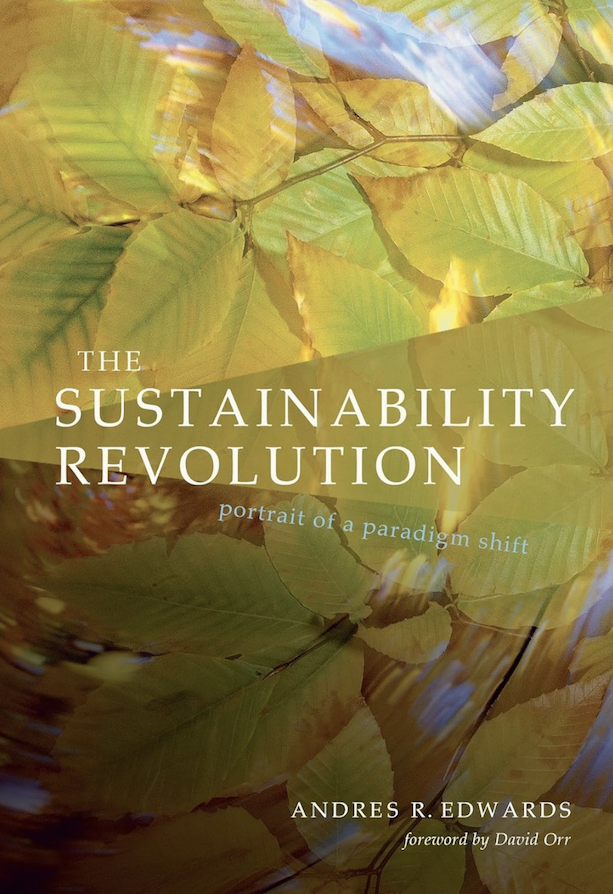
The Sustainability Revolution: Portrait of A Paradigm Shift
by Andrés R. Edwards, New Society Publishers (Seventh Printing), 2005
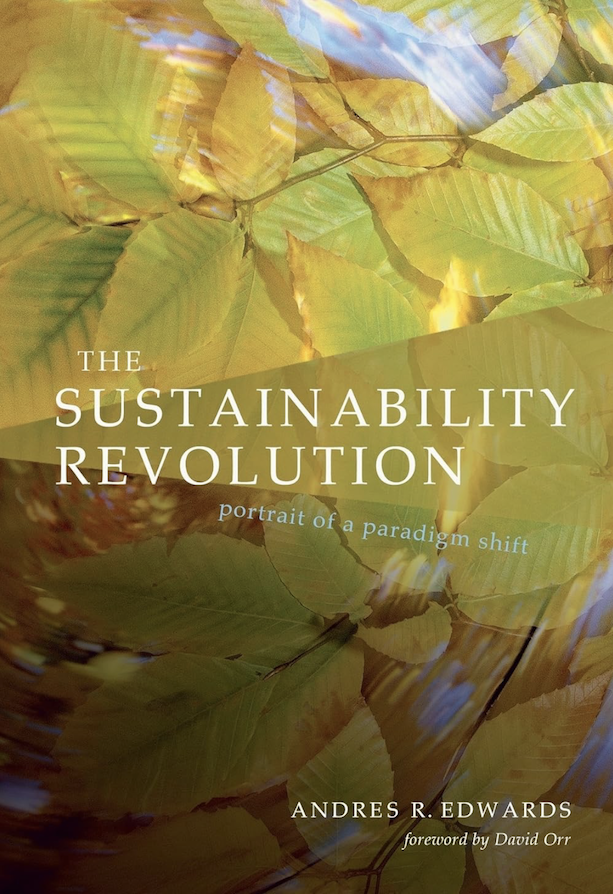
Selected by Apple to demonstrate the educational potential of ebooks used in conjunction with the iPad platform in academic settings, The Sustainability Revolution provides a comprehensive primer on the history, evolution and future of the movement toward sustainability. Sustainability has become a buzzword in the last decade, but its full meaning is complex, emerging from a range of different sectors. In practice, it has become the springboard for millions of individuals throughout the world who are forging the fastest and most profound social transformation of our time, the Sustainability Revolution.
The Sustainability Revolution paints a picture of this largely unrecognized phenomenon from the point of view of five major sectors of society:
Community (government and international institutions)
Commerce (business)
Natural Resources (forestry, farming, fisheries, etc.)
Ecological Design (architecture, technology)
Biosphere (conservation, biodiversity, etc.).
The book analyses sustainability as defined by each of these sectors in terms of the principles, declarations and intentions that have emerged from conferences and publications, and which serve as guidelines for policy decisions and future activities. Common themes explored include: stewardship, economic restructuring, respect for the principles of nature and an intergenerational perspective on solutions.
Concluding that these themes in turn represent a new set of values that define this profound transformation, The Sustainability Revolution describes innovative sustainable projects and policies improving the lives of people in Colombia, Brazil, India and the Netherlands and examines future trends. The first book of its kind, it will appeal to business and government policy makers, academics, and all interested in sustainability.
-
FOREWORD
by David W. OrrAt the end of his life, science-fiction writer and historian H. G. Wells was no optimist. Surveying things from his vantage point at the close of World War II and not long before his own death he wrote: "The end of everything we call life is close at hand and cannot be evaded" (H. G. Wells, 1946, p. 1). And 58 years later, Martin Rees, England's Astronomer Royal and professor at Cambridge University, was no more optimistic, giving humankind 50-50 odds of making it to the year 2100 (Rees, 2003, p. 8). Indeed, any moderately well-informed high-school student could easily assemble a list of dozens of ways things could all come undone, ranging from whimpers to bangs. Gamblers at some intergalactic casino would not likely bet much on us. And what can be said for such a violent bunch that seems so intent on mutilating its own earthly home? We are a long shot, but so, too, were those small, unimpressive mammals scurrying about amidst the invincible dinosaurs of their time. If such intergalactic bets are being placed, there are a perceptive few who might see a modern-day equivalent to that earlier time when the long shot paid off. The small, vulnerable and unimpressive mammals won for many reasons, including their agility, resilience, adaptability and intelligence-to-body-mass ratio.
All informed citizens know about the perils ahead, including rapid climate destabilization, species extinction, pollution, terrorism and ecological unraveling in its many forms, and the human, political and economic consequences. But fewer have stopped to look at the wider topography, where something quite remarkable is occurring. Below the radar screen and outside the cultural buzz, a revolution is beginning to gather steam at the grassroots and in out-of-the-way places around the world. While the headlines report one military excursion or another on the chessboard of geopolitics, or yet another "triumph" for the juggernaut of globalization, people and small organizations with long names and short budgets are beginning to construct a different world. As unimpressive as those small furry mammals were relative to the giants of a distant time, the outline of something far better is beginning to emerge in communities and organizations around the world.
It is happening first at the periphery of power and wealth, where revolutions often start. It is evident in farmers beginning to mimic natural systems in order to preserve their soil and land. It is evident in a new attitude emerging everywhere about the value of biological diversity and species protection. It is evident in the rapid development of technologies that harness sunlight and wind. It is evident in the burgeoning interest in green building, green architecture, green engineering and green communities. It is evident in a growing number of businesses selling "products of service" and preserving natural capital as a matter of conscience and profit. It is evident in a new religious sensibility across the full spectrum of faith traditions that regards stewardship of the Earth as obligatory. It is evident in education and the emergence of new ways to think about the human role in nature that stretch our perspective to whole systems and out to the far horizon of imagination.
The "it" is often called "sustainability," an indefinite term. But by whatever name, this revolution is more sweeping by far than that which we associate with the Enlightenment of the 18th century. The sustainability revolution is nothing less than a rethinking and remaking of our role in the natural world. It is a recalibration of human intentions to coincide with the way the biophysical world works. It is a slowing down to the rhythms of our bodies, convivial association and nature. The concern for our longevity as a species represents a maturing of our kind to consider ourselves first as "plain members and citizens" of an ecological community, and second as trustees of all that is past with all that is yet to come — a mystic chain of gratitude, obligation, compassion and hope.
If this revolution grows and matures as I believe that it will, it will do one other thing: it will improve our worthiness to be sustained. Imagine a tribunal of all species sitting in judgment over Homo sapiens charged to rule on our fitness to remain on Earth based on our behavior over the past ten thousand years. How would we be judged? Other than the votes of cockroaches, crows and any number of viruses, the motion to evict us would win by a large margin. Even to raise the question, however, would be taken as a sign of misanthropy or worse. But failure to do so rests on the fatal assumption that we live outside the community of life and beyond the call to a larger duty than that of human dominion. The revolution described here, in other words, is not simply about making ourselves physically sustainable at whatever cost, but rather about something akin to a species maturing into its fullest stature -- one worthy of being sustained — a revolution of charity, magnanimity and spirit.
In the pages that follow, educator, designer and consultant Andrés Edwards paints what he calls a portrait of this revolution. His description crosses national boundaries as well as the divisions between academic disciplines and sectors of the economy. The sustainability revolution is steadily reshaping our lives and our place in the larger fabric of life for the better. But there is nothing inevitable about any revolution or about any good thing. Ultimately these are matters of choice and fate. But this book helps us put the odds in perspective and clarify the point that despair can be overcome by a revolution of hope, competence and intelligence underlain by wisdom.
David W. Orr is Paul Sears Distinguished Professor, Oberlin College, and is the author of Ecological Literacy, Earth in Mind, The Nature of Design, and The Last Refuge.
-
TABLE OF CONTENTS
Acknowledgments
Foreword by David W. Orr
Introduction: Portrait of the Sustainability Revolution
Anatomy of Social Revolutions
Movements and Revolutions
The Five Characteristics of the Sustainability Revolution
A Revolution of Interconnections
Chapter 1: The Birth of Sustainability
The Context
Environmentalism: The Precursor to Modern Sustainability
Contemporary Environmentalism: The Roots of Sustainability
The Emergence of Sustainability: Brundtland (1987) and Rio (1992)
The Core of Contemporary Sustainability: The Three Es
The Three Es Plus One: Education
The Methodology: Fundamental Principles
Criteria for Selecting Principles
Principles as Songlines
Chapter 2: Sustainability and Community
Interdependence at All Levels
Ontario Round Table on Environment and Economy (ORTEE) Model Principles
Principles of Sustainable Development for Minnesota
The Netherlands National Environmental Policy Plan (NEPP)
The Earth Charter
International Council of Local Environment Initiatives (ICLEI)
Integrating Sustainability Values at All Community Levels
Chapter 3: Sustainability and Commerce
Beyond “Business as Usual”
Adopting Sustainable Strategies
The Precautionary Principle
The Natural Step
The Houston Principles
The CERES Principles
The ICC Charter and ISO 14000
Environmental Assessments and Green Taxes
A New Business Model
Chapter 4: Sustainability and Natural Resources
The Contradictions of Resource Extraction American Petroleum Institute (API) Environmental, Health and Safety Principles
Forest Stewardship Council (FSC) Principles and Criteria of Forest Stewardship
Marine Stewardship Council (MSC) Principles and Criteria for Sustainable Fishing
The Asilomar Declaration for Sustainable Agriculture
Natural Resources at a Crossroads
Chapter 5: Sustainability and Ecological Design
Designing with Nature
The Hannover Principles
The Five Principles of Ecological Design
The Todds’ Principles of Ecological Design
The Sanborn Principles
US and World Green Building Councils: The LEEDing Edge
An Interdependent Perspective
Chapter 6: Sustainability and the Biosphere
Our Role in the Biosphere
Deep Ecology's Basic Principles
Charter of Rights and Responsibilities for the Environment
Biomimicry Principles
Permaculture Principles
A Biocentric Perspective
Chapter 7: Future Pathways
Principles: Scopes, Sectors and Types
Seven Common Themes
Hopeful Signs
Our General Predicament
Seeking an Alternative Path
Beyond Green: A New Vision of the Future
Resources
Organizations
Online Publications/Newsletters/List Servers
Additional Principles
Annotated Bibliography
Notes
Index -
Reviews and Endorsements
Like a father penciling his kids' height marks on a door jamb, Andrés Edwards has lovingly taken the measure of the sustainability movement's leaps-and-bounds growth. Seeing our collective wisdom arrayed in a single book is powerful medicine for long-time solution seekers, and an irresistible invitation to a new generation wondering "How Shall We Live Here?"
-- Janine Benyus, author of Biomimicry: Innovation Inspired By Nature and Co-founder, Biomimicry Guild
The Sustainability Revolution presents a clear, concise, straightforward articulation of the most powerful force sweeping the world. This book is a great source of inspiration, showing us just how much is going on behind the scenes all over the world.-- Spencer B. Beebe, founder, Ecotrust
In The Sustainability Revolution, Andrés Edwards has written a compelling, practical guide to the rapidly evolving field of sustainability. Whether you're a business person, journalist, educator or citizen activist, this book illustrates dozens of ways the environment can be restored while at the same time opening up new economic opportunities.-- Christopher Flavin, President, The Worldwatch Institute
No need to reinvent the sustainability wheel! In The Sustainability Revolution, Andrés Edwards collects a comprehensive set of sustainability principles into the definitive desk reference. The principles are complemented with an excellent overview of social movements and the evolution from environmentalism to sustainability. This book is a fundamental tool for those building a better world -- a must for your library!
-- Randy Hayes, founder of Rainforest Action Network, director of sustainability for the City of Oakland
The Sustainability Revolution is an immensely useful book. Edwards provides an impressive guide to the future by examining pathbreaking actions and innovative ideas already moving ahead in today's world. The Sustainability Revolution is at once practical and visionary.
-- James Gustave Speth, Dean, Yale School of Forestry & Environmental Studies
The Sustainability Revolution is a compelling reminder of the power each of us has to make this world a better place through our everyday actions. Indeed, if we are to survive we must recognize our place in the natural world and make a concerted effort to leave lighter ecological footprints. The Sustainability Revolution shines light on the path that we all must follow to make this world a more sustainable and peaceful place for all living things.
-- Dr. Jane Goodall, DBE, Founder, The Jane Goodall Institute, UN Messenger of Peace
As Andrés Edwards clearly demonstrates, we are indeed in the early stage of a global sustainability revolution, and yet few of us can see it. The Sustainability Revolution gathers together accounts of the underlying dynamics, global visions, definitions and effective models of this quiet revolution, and informs us of the most important societal movement ever; one that will not only change the essence and metrics of business, but will determine our future.
-- David A. Gottfried, founder, US and World Green Building Councils and author of Greed to Green
The Sustainability Revolution is a key reference for environmentalists -- the kind of reference that will fuel good work and good thinking in the years to come.
-- Bill McKibben, author of Wandering Home, Enough and The End of Nature
Andrés Edwards has done society a great service with The Sustainability Revolution. He has helped us envision a sustainable world and given all of us hope about the future by illuminating the thousands of positive efforts worldwide that are helping move toward this vision. The book is both an inspiration and a testimony to the programs that are hardly ever addressed by the mainstream media. It is a much-needed shot in the arm for the sustainability movement.
-- Anthony D. Cortese, president of Second Nature, leader in the Education for Sustainability movement in higher education
Andrés Edwards maps one of the most significant yet least understood landscapes: the landscape with the paths to the place where all people can flourish, within the means of one generous, but ultimately limited planet. His map brings clarity to the formerly confusing mountains and valleys of sustainability principles, ideas, concepts, and indicators. I wish this book becomes everybody's "Rand McNally Atlas" to guide us on the rally to sustainability. This is the best rally since we can all win. Andrés' brilliant book shows us how.
-- Mathis Wackernagel, Executive Director, Global Footprint Network
Andrés Edwards has written a much-needed book - a comprehensive, extremely readable guidebook to the Sustainability Movement, its history, principles, and applications. At a time when so many people feel the bad guys are winning, Edwards shows us the quiet good news that doesn't get headlines, yet is changing the world for the better as "business as usual" unravels. We and the planet have a chance. The Sustainability Revolutionshows why and how in this carefully researched, passionate book.
-- Sim Van der Ryn, architect, author of Ecological Design and Design For Life
The Sustainability Revolution is a passionate, hopeful account of the shift in thinking that's happening worldwide. Andrés Edwards provides a profoundly encouraging confidence booster -- definitely required reading for anyone thinking about or working within the sustainability movement.
-- L. Hunter Lovins, president, Natural Capitalism Inc., and co-author of Natural Capitalism: Creating the Next Industrial Revolution
The Sustainability Revolution provides a brilliant synthesis of the multiple braids of sustainability. Its comprehensive analysis of sustainability principles and frameworks is particularly valuable.
-- Stuart Cowan, co-author of Ecological Design
What is ecological sustainability, and is it one consistent thing? And can we protect the children of the future and still make a good living today? Andrés Edwards has given us an elegant and concise way to say 'Yes!' to both questions. He shows just how coherent is the worldview of the sustainability movement, and that its principles and practices are moving steadily from grand ideas, and statements of alarm, toward actual, everyday practicality. Today dozens of industries, hundreds of communities and thousands of companies have found that what is practical for everyday economic activities can be redesigned to be very good for the environment and our long-term future. So the more concrete and practical are those big sustainability principles, the more they spread around the planet as actual green practices. It's not just that "a better world is possible." It's happening. It's real.
-- Paul H. Ray, co-author of The Cultural Creatives
Sustainability is more than a buzzword; it is a concept that defines what is needed for our civilization to survive. The discussion about sustainability is therefore the most important one now occurring on the planet. Andrés Edwards has summarized the current state of this discussion in a thorough, upbeat, and understandable way. The Sustainability Revolutionhighlights not only the ideas, but the courageous efforts of people around the world who are creating a way of life that is not only more survivable, but more just and satisfying as well.
-- Richard Heinberg, professor of human ecology, New College of California, and author of The Party’s Over: Oil, War and the Fate of Industrial Societies and Powerdown: Options and Actions for a Post-Carbon World
By the simple act of gathering in one place dozens of lists of "sustainability principles," Andrés Edwards has sketched the landscape -- and given us a glimpse of the trajectory -- of the sustainability revolution.
-- Gil Friend, President & CEO, Natural Logic Inc., and author of A Declaration of Leadership
"This book is a compelling reminder of the power each of us has to make the world a better place."
-- Resurgence Magazine
"This is an excellent summary of how the idea of sustainability came to grip the ecology movement.-- Philip Woodard, Planet Drum Pulse
In this book, Edwards, an educator and media designer who has specialized in sustainability topics for the last 15 years, briefly sketches a portrait of the sustainability revolution as a social movement that contains a “revolution of interconnections.” Summarily describing the birth of sustainability, he then applies sustainability thinking and practice to four areas: (1) community, (2) commerce, (3) natural resources, and (4) the biosphere.Deftly summarizing in some 20 pages each the important developments in each area, Edwards adds a useful resources chapter of organizations, as well as online resources for each of those areas. His last chapter, “Future Pathways,” presents an original two-and-one-halfpage table that traces the development of the principles of sustainability, divided into scopes, sectors, and types, and argues that we must go “beyond green” towards a new vision of the future. The book concludes with an annotated bibliography.
The Sustainability Revolution is particularly useful for environmental educators, for it presents in clear, concise language a compelling, practical guide to the rapidly evolving field of sustainability. It shows how environmental education can transition into a “sustainability framework,” which would give EE greater depth and make it more effective in enhancing personal and organizational perspectives that match the urgent plight of people and planet.
Sustainability is more than a buzzword: It is a concept and a movement that defines what civilizations need to survive. Therefore, by seriously considering sustainability principles in their environmental education work, educators engage in perhaps their most important work to date. They would be critically applying their expertise in the articulation of this most powerful force that is today sweeping the world, for it is civilization that is at stake.
In other words, evaluating one’s work in terms of sustainability is a variant of the question: Are we doing the right thing or are we doing things right?
Frans C. Verhagen (gaia1@rcn.com) is a sustainability sociologist, the director of sustainability research and education at Earth and Peace Education Associates International (EPE), and adjunct associate professor of sustainable communities at Pace University in New York, NY..
-- NAAEE Communicator North American Association for Environmental Education (NAAEE) Spring 2006, Vol. 36/No. 2
After briefly sketching a portrait of the sustainability revolution as a social movement that contains a "revolution of interconnections," Edwards, an educator and media designer who has specialized in sustainability topics for the last 15 years, summarily describes the birth of sustainability. Then he applies sustainability thinking and practice to four areas: community, commerce, natural resources and the biosphere. He deftly summarizes in some twenty pages each the important developments in each area, adding a very useful resources chapter of organizations, online resources for each of those areas. His last chapter, entitled ÒFuture PathwaysÓ presents a very original two and half page table that traces the development of the principles of sustainability, divided into scopes, sectors and types and argues that we have to go "beyond green" towards a new vision of the future. The book of some 200 pages that sells for $16.95 concludes with an annotated bibliography.This book is particularly useful for environmental educators, for it presents in clear, concise language a compelling, practical guide to the rapidly evolving field in sustainability. It shows how environmental education is to transition into a sustainability framework which would give it greater depth and make it more effective in enhancing personal and organizational perspectives that match the urgency of the plight of people and planet. Sustainability is more than buzzword: it is concept and movement that defines what is needed for civilizations to survive. Therefore, seriously considering sustainability principles in their environmental education work, educators are engaged in perhaps the most important evaluation of their work. They would be critically participating for their field of expertise in the articulation of this most powerful sustainability force that is sweeping the world. It is a variant of the question: Are we doing the right thing or are we doing things right?
-- Frans C. Verhagen, M.Div., M.I.A., Ph.D., a sustainability sociologist, is the director of sustainability research and education at Earth and Peace Education Associates International (EPE) and adjunct associate professor of sustainable communities at Pace University
Also published by New Society Publishers is a book authored by Andres Edwards, The Sustainability Revolution: Portrait of a Paradigm Shift - must reading for anyone who wants to understand the roots and development of our field. It traces its history, how it emerged, its core philosophies and tools.It covers government and international institutions; corporate; forestry, farming and fisheries; architecture and ecological design; and biodiversity conservation. www.sustainabilityrevolution.com
Edwards is the founder of EduTracks, which creates educational exhibits for parks, towns and companies on green building and sustainability.
-- Sustainable Business.com
"As to methods there may be a million and then some, but principles are few. The man who grasps principles can successfully select his own methods. The man who tries methods, ignoring principles, is sure to have trouble."There's a brand new book on sustainability from New Society Publishers. The Sustainability Revolution: Portrait of a Paradigm Shift briefly introduces the birth of sustainability and then presents many sets of sustainability principles in five chapters: Sustainability and Community, Sustainability and Commerce, Sustainability and Natural Resources, Sustainability and Ecological Design and Sustainability and the Biosphere.
This is also a very comprehensive list of resources. It could be seen as a 'sustainability encyclopedia'. It is quite accessible: less than 20 pages long. A very good resource indeed and a good reference book on sustainability for those who don't know much about the concept.
-- The Watershed Sentinal
Andres R. Edwards' The Sustainability Revolution: Portrait Of A Paradigm Shift (0865715319, $16.95) tells of millions around the world who are undertaking the Sustainability Revolution, incorporating the values and foundations of sustainability into their lives, policies, and businesses. Chapters trace the origins and enactments of different principles, design values, and alliances with an eye to showing how these connections are made, fostered, and grow.-- Midwest Book Review
The Sustainability Revolution is a thorough review of the evolution of sustainability. For a text loaded with facts and details, Andres wrote it so it would be understandable for those who are new to the history and principles of sustainability. The resources section is especially helpful because it lists organizations and contacts mentioned in the book along with brief descriptions about them. I'm sure that many of our customers -- for the DVD "Architecture to Zucchini: The people, companies and organizations pioneering sustainability" -- would be very interested in this book. I highly recommend it to higher education, consultants and business leaders.-- Doug Freeman, Arnold Creek Productions
A comprehensive and readable distillation of the topic; a decent primer for understanding sustainability's many dimensions, and for sharing with colleagues.-- The Green Business Letter
During the past two decades, "sustainability" has become a catchword, yet few people know exactly what it is supposed to mean. Most dictionaries don't even define it but rest content with a definition of the adjective "sustainable." Part of the problem is that the word can signify several things, depending on the context. Even David Orr, in his foreword to the present book, speaks of it as an "indefinite term," and yet in the context of ecology and economy, "sustainability" does in fact have a specific sense.Edwards, who is an educator and environmental systems consultant, has written over 200 pages to explain what sustainability stands for and why it is such a vital concept today. Already millions of people have rallied around this notion, so that it is possible to speak of a "Sustainability Revolution"-an international social movement that emphasizes a mature, responsible approach to living, which is not detrimental to our Earth habitat nor our fellow beings (both human and nonhuman). This movement is made up of thousands of interest groups worldwide, each of which has its own concerns and agenda, but these synchronize with the concerns and agendas of other groups.
The present book is something of a manifesto for the Sustainability Revolution. After examining the movement's history, he analyzes its core concerns-the three "E's," namely ecology/environment, economy/employment, equity/equality, to which he adds education of the larger public. He then goes on to analyze sustainability in terms of community, commerce, natural resources, ecological design, and the biosphere-all key issues in the Sustainability Revolution and all related to each other.
Edwards's clear mind, formidable command of his material, and sharp eye for common principles make his book a remarkable and convincing document, which undoubtedly will become a classic reference work.
-- Georg Feuerstein, PhD
Recent intellectual stints into the Big Picture of Sustainability trying to place thoughts within the current destructive economic and industrial paradigms had me searching for some additional perspectives on the matter. Luckily a quick Amazon search led to me to this incredibly useful little book that details the history of Sustainability over the past 200 years focusing most intently on the past 20 years as momentum picked up. Of interest to many readers will be the incredibly detailed Resource Section that includes 28 pages of Organizations, followed by a 15 page annotated bibliography. A true Who’s Who of Sustainability today that is a great launching point for additional study.Edwards traces the history of Sustainability back to the early 19th century and the Transcendentalist of America. Emerson’s essays on Nature and Self Reliance are as poignant today as ever, and where would we be without Thoreau’s Walden and Civil Disobedience? Of special importance to Edward’s was the Transcendentalist’s connection between Nature and human wisdom and spirituality through its symbolism and connection with the Divine. The role of Nature as teacher was further developed in the early 20th century Naturalists, of which John Muir is perhaps the most notable. Muir’s works Our National Parks and Yosemite focused more on the systemic nature of Nature and also laid out the basis for conservation by detailing the impacts of ranching on our wild lands. Aldo Leopold picked up the torch in the 1940’s by intimately tying ecosystems to our survival in The Sand County Almanac and was one of the clearest voices establishing Conservation as an ethical decision. Twenty years later, Rachael Carson’s Silent Spring roused a sleeping nation to the dangers of our New World Order and generated enough momentum to found the Environmental Movement culminating in Senator Gaylord Nelson’s first Earth Day in 1970. This movement reached critical mass with the passage of such landmark legislation as the Clean Water Act, the Clean Air Act, and the establishment of the EPA. All of this led up to the first landmark event on a Global scale in 1972 with the United Nations Conference on the Human Environment in Sweden. These notables all led up to what Edward’s considers the birth of Sustainability with the World Commission on Environment and Development report in 1987 which defined Sustainability as “development that meets the needs of the present without compromising the ability of future generations to meet their own needs”.
Edward’s differentiates between the Environmental Movements of the 1960’s/70’s which were issue based and typically led by charismatic leaders like Carson and Nelson with the Sustainability Revolution that he sees today which is much broader and lacks one central figurehead. Edward’s identifies a Core of Sustainability with the following 3 categories:
Ecology/Environment This "E" is framed by three broad concepts: long term not short term thinking, a focus on the systemic understanding of ecosystems critical importance to human life, and finally the strongly held belief that there are limits to the amount of life that the ecosystems of the Earth can support.
Economy/Employment Here is where Edwards begin to grow beyond the traditional Environmental movement. Sustainability focuses on the critical importance of secure, employment and economies that do not overstretch their ecosystems. There isn't a community on Earth that can be truly sustainable if they cannot meet the needs of their citizens-impoverished Africans will harvest bushmeat and American farmers will turn more and more to industrial agriculture without a viable economic alternative to feed their families and pay their bills.
Equity/Equality Without going all socialist here, the world may not currently have a resource shortage, but it certainly has a distribution problem. Ok, I'll go a little socialist-moral issues such as famines and homelessness are all the more terrible because they are preventable if we could just redistribute the wealth/resources already in use in our society. Edwards also stresses community building in this "E" recognizing the inherent importance in concern and cooperation with ones neighbor. "At a fundamental level, members of a sustainable community understand that the well being of the individual and the larger community are interdependent."
The bulk of Edwards’ book is spent flushing out these 3 categories and providing actual organizations or conferences that address them specifically. Edward’s also spends a lot of time defining Principles for each category and looking for common themes. In Chapter 2 he delves into Sustainability and Community with great examples like the inspiring Netherlands National Environmental Policy Plan (NEPP) and the Earth Charter. Further chapters devote time to Commerce, Ecological Design, Natural Resources, and the Biosphere. Subsequent chapters spend several pages each with an organization that is on the leading edge of driving change in their area of expertise providing fantastic examples of how we can all “be the change we wish to see in the world”.
Edwards concludes the book by identifying Seven Common Themes that all the detailed organizations have in common:
Stewardship
Respect for limits
Interdependance
Economic restructuring
Fair Distribution
Intergenerational perspective
Nature as a model and teacherThese themes can be seen at work in areas such as Curitiba, Brazil and Kerala, India where governments are literally changing the way that cities and regions are run to create ore sustainable paradigms. Edwards concludes that “Sustainability offers the possibility of brining social change values into the mainstream and pushing the mainstream toward sustainable practices.” I will leave you with a beautiful quote from the Netherlands’s Green Plan NEPP4:
“All humans seek to survive, to live healthily and to live meaningfully. This still does not add up to a sustainable life however. A sustainable life involves more: a realization, for example, that humans are not the only living creatures on the planet and must respect all life. And it involves, for example, the shouldering of responsibilities in a range of different roles: as citizens, as producer, as consumer or as citizen of the world. By bearing responsibility for the social, economic and ecological consequences of our actions both now and later… …we will bring sustainable development closer.”
Andres Edwards’ book is a great primer for anyone seeking to become more intimately aware of the myriad diverse initiatives in action across our globe as we try to dig ourselves out of this mess. The Doom and Gloom is easy, Edwards provides real proof that there are hundreds of thousands of intelligent, inspiring people fighting for a better way across the globe. Learning from them is a both a necessity and a pleasure.
Interested in learning more? Here are some great links and books included in the Resources section of the book:
The Earth Policy Insitute
The International Institute for Sustainable Development
Natural Capitalism Solutions
The Rocky Mountain Institute
The Global Footprint Network
The Natural Step
The Land Institute
US Green Building Council
The Permaculture Research InstituteShould Reads:
Natural Capitalism
Cradle to Cradle
Biomimicry
Permaculture: Pathways and Principles
The Natural Step for Communities-- Groovy Green, written by Beo
-
EcoTalk Radio, Nationally Syndicated (11 min.) May 16, 2007
EcoTalk show host Betsy Rosenberg interviews Andres Edwards about his book, The Sustainability Revolution. Andres discusses the trend towards sustaiable practices and topics including Tibet, deep ecology and green building.
Earthwatch Radio, Nationally Syndicated, Madison Wisconsin(4 min.)
October 14, 2005Earthwatch Radio show host Steve PumplunRathbun interviews Andres Edwards about his book, The Sustainability Revolution. Andres describes the emergence of awareness of sustainability ideas practices in communities, the business, building and non-profit sectors.
Tibet: Enduring Spirit, Exploited Land
by Andrés R. Edwards, New Society Publishers, 2019
Explore our emotional bond with nature to heal ourselves and the natural world
Why spend countless hours indoors in front of screens when being in nature feels so good? In learning why and how to nurture our emotional connection with nature, we can also regenerate the ecosystems on which we depend for our survival.
Renewal explores the science behind why being in nature makes us feel alive and helps us thrive. Using personal experiences and cutting-edge research in cognitive science, this book weaves delightful stories that:
Reveal nature's genius and impacts on our lives from physical, emotional, intellectual, and spiritual perspectives
Explore how emulating nature is yielding design breakthroughs with biomimicry and biophilic design
Highlight the importance of compassion and coexisting with wildlife in designing our conservation strategies
Describe the significance of nurturing an ecological ethic that supports a reciprocal relationship with nature.
Whether you are drawn to conservation or are interested in the science behind human behavior, Renewal will help create a blueprint for integrating nature with a life of creativity, compassion, and joy.
-
FOREWORD
by The Dalai LamaThe people of Tibet for centuries have adhered to spiritual and environmental values in order to maintain the delicate balance of life. Tibetans have a great respect for all forms of life. The concepts of non-violence, compassion, and the interdependence of living and nonliving elements of the earth, teach us to be more caring and more concerned about others and our surroundings. This belief is further strengthened by the Tibetan Buddhists’ traditional adherence to the principle of self-contentment: that the environment should be used to fulfill one’s needs, and not greed.
Prior to China’s invasion in 1949, Tibet was a beautiful and unspoiled wilderness sanctuary in a unique natural environment. Unfortunately, during the last few decades, Tibet’s wildlife and environment has been severely damaged and in many places the damage has been irreparable. The unique Tibetan way of life has been trampled upon by a materialistic and atheist attitude. The environment of Tibet is now plagued with rampant deforestation and excessive mining. It is further threatened by the increasing number of Chinese settlers pouring into Tibet for short-term economic gains.
The significance of the Tibetan Plateau could be understood from the fact that it is the source of ten major rivers, which are the lifeline of millions of people living in Asia. What happens in Tibet has a direct bearing on the lives of millions of people living downstream. The environmental balance of Tibet also affects the global weather pattern as recent scientific research shows.
At this crucial stage, Tibetans in Tibet and in exile need, more than ever before, the assistance of the global community in their endeavour to protect their homeland. Tibet’s environment, with its xviii distinct cultural heritage and national identity, can only be preserved if a mutually agreeable political solution is found to the Tibetan problem. I have been making every effort over the years to facilitate negotiations with the Chinese government. I appeal to various governments, organizations, and individuals to bring China to the negotiating table. I welcome this book and am sure that it will help in creating more awareness among the people about the tragic ecological plight of Tibet and move them to help save Tibet.
-
TABLE OF CONTENTS
Foreword By The Dalai Lama
Introduction
Chapter 1: Ecology of the Land and People
Chapter 2: The Geography of the Land of Snows
Chapter 3: The Nomadic Way of Life
Chapter 4: The Reapers
Chapter 5: Endangered Land
Chapter 6: Endangered Tibetans
Chapter 7: Tibet As a Living Model
Epilogue: The Sheltering Tree of Interdependence
Appendix A: Background of Tibet: Enduring Spirit, Exploited Land
Appendix B: The Environment and Human Rights.
Appendix C: Environment and Development Guidelines
Appendix D: Tibet Support Organizations
Appendix E: Map of Tibet
Appendix F: Biodiversity of the Tibetan Plateau
Appendix G: Tibet: Human Rights and the Rule of Law
Appendix H: The Right to Development on the Tibetan Plateau (HRT)
Appendix I: Tibetan Government in Exile Releases Reports on Tibet at World Summit on Sustainable Development (WSSD)
Bibliography
Photographers' Credits
Index -
Reviews and Endorsements
From: The Dalai Lama
The significance of the Tibetan Plateau could be understood from the fact that it is the source of ten major rivers, which are the lifeline of millions of people living in Asia. What happens in Tibet has a direct bearing on the lives of millions of people living downstream. The environmental balance of Tibet also affects the global weather pattern as recent scientific research shows. I welcome this book and am sure that it will help in creating more awareness among the people about the tragic ecological plight of Tibet and move them to help save Tibet.-- His Holiness the Dalai Lama
From: Library Journal, May 1, 1998
Tibet today is inhabited by 7.5 million Chinese and 6 million Tibetans. Lhasa, the capital, has more than twice as many Chinese as Tibetans. Along with this in-migration, and its many cultural implications have come widespread changes in the natural environment, including deforestation, mining exploitation, new practices of agriculture that raise yields but introduce chemicals and pollution, and reduced habitat for wildlife. This book is a plea for foreign pressure to preserve Tibet as an environmental and cultural buffer "zone of peace" between China and India. Appendixes list Tibet support organizations and environment and development guidelines issued by the Tibetan Government-in-Exile. An abundance of photographs depict the landscape and the nomadic life it has traditionally supported, along with some of the ravages now taking place. A powerful book suitable for both public and academic libraries.Harold M. Otness, Southern Oregon Univ. Lib., Ashland
From Publishers Weekly, April, 27, 1998
Tibet: Enduring Spirit, Exploited Land reveals the beauty of the land and it’s people and the abuses they have both endured. Robert Z. Apte, a psychiatric social worker and Chilean ecologist Andres R. Edwards show how the often nomadic or semi-nomadic herders and farmers of Tibet have had their ways of life disrupted, and, along with the Dalai Lama (who provides a foreword), call for action.(Heartsfire, $29.95 192 pg., ISBN 1-8889797-11-1; May)
From: Booklist
Since the Chinese occupation of Tibet, the country and its people have suffered immesurably. In pictures and words, Apte and Edwards celebrate the harmonious co-existence of Tibetans with their land before the takeover, then they go on to document the devastation and destruction occuring today. The once unspoiled harsh beauty of the landscape that Tibet’s nomads and farmers revered and respected for centuries is shown to be ravaged by clear-cutting of forests, killing of endangered species, and harsh treatment of a dwindling Tibetan populace. The efforts of Apte and Edwards resulted in recorded interviews and photographic evidenceof the ecological assault Tibet suffers under China's rule. In chronicling the vast damage to Tibet’s environment, they make a plea for an end to the continuing oppression of Tibetans and their culture, proposing that the country become what the Dalai Lama calls a zone of peace.-- Alice Joyce, Booklist
From: David Brower
Few books have looked into the lives of nomads and farmers of Tibet and how they have been able to lead satisfying lives in the sparse high altitude area north of the Himalayas. The authors depict the value of the environmental wisdom gathered by the Tibetans over the millennia. Their writings and interviews with nomads and farmers illustrate the tremendous loss to the world by ignoring the ongoing impact of the Chinese occupation. Apte and Edwards see some hope for the future as the world bodies better understand the need for a neutral Tibet established as a Zone of Peace.-- David Brower, Founder and Chairman, Earth Island Institute. Former Executive Director, The Sierra Club
From: Helena Norberg-Hodge
Tibet: Harvest of the Spirit is a book that must be read by all those who have concern for the environment that goes beyond local issues. While it deals with the struggles and triumphs of the Tibetan nomads and farmers before and during the Chinese occupation, it brings into sharp focus the price the world must pay if it continues to turn a blind eye to the events in the ÒLand of Snows.Ó Behind the nomads and farmers’ reverence and respect for the land is found an intuitive understanding of environmental laws and an impressive land ethic. Apte and Edwards fear that this knowledge will be lost to the world while the Chinese vigorously impose on them a western style of industrial development. Their story is not only told in words, but hilighted in a series of stunning photographs. The authors are to be congratulated for covering this tragic and unfolding international ecological event through the compelling accounts of Tibetans and observers witnessing these dramatic changes.-- Helena Norberg-Hodge, author of Ancient Futures
From: Horace E. Sheldon
This is a book filled with compelling truths beautifully told and enriched with color photographs that abet the text by conveying the mood of the land and its people. There are truths about mans’ relation to the natural world and about the most basic of life’s values. They spring from the lives of the Tibetan people at least as they were allowed to live there before their society was overwhelmed from the outside.Apte and Edwards document how after its military takeover of Tibet in 1950, China systematically has plundered its land and subjected its people to a harsh rule. Hillsides are being denuded of their forest and left to be washed down to the rivers feeding India. Thousands of monasteries have been blown up in an effort to stamp out the peoples’ Buddhist faith.
The world of the 1990s challenges the human conscience from genocide in parts of Africa to ethnic cleansing in the Balkans. But our impulse to want to do “something” is frustrated by the complex realities of each gross violation of human decency, and by national sovereignty. Of all the tragic happenings unfolding in the world today, those in Tibet somehow demand our special concern.
It is not just the appeal of this remote land of mystery of James Hilton’s Shangrila. It is the tragedy of witnessing in our very own decades the steady destruction of a way of life and of a system of values sustained for centuries that is unduplicated elsewhere on earth.
As the authors stress, the loss is to all of us and they tell us why. What we stand to lose in an on-going living model of how to come to terms with the natural world and with each other from which all individuals can learn. As the book puts it, if the Tibetans can regain their independence we can profit much from “a culture with an immense spiritual abundance and an earth-based wisdom.”
To those with no knowledge of Tibet, this may seem an over-reaching assertion. But, when the reader digests the accounts of the day-to-day ways in which Tibetans live out their “reverence for life” extending it to all sentient beings, even insects its sound basis becomes clear.
This is an important and very readable book for all the world to share.
--Horace E. Sheldon
Retired Himalayan Trekker, visited Tibet in 1987. Retired Director, Governmental Affairs Office, Ford Motor CompanyFrom: Independent Publisher
As the title implies, this primer on the Chinese domination of Tibet is not a scholarly study, nor a particularly balanced exploration, but a call to action. The comparisons the authors make between Tibet and the historical displacement and marginalization of Native Americans are particularly compelling as Apte and Edwards, environmentalists and human rights advocates decry the systematic decimation of the Tibetan people, their culture, religion, and--the focus of this book--the Tibetan ecosystem. With the aid of photographs and interviews, the authors offer a general introduction to Tibet, leading to the argument that Tibetan reverence for land has been routinely and brazenly ignored as deforestation, mining, and oil drilling takes its toll on the once pristine landscape.Despite the careful research the authors present, there is at times the tendency to oversimplify the issues for the sake of brevity. When, for example, the authors agree that the recent economic reforms the Chinese are pushing onto Tibet are a more subtle means of control, they also acknowledge that these reforms are raising the standard of living, but quickly add that “oppressive regulations remain a roadblock."Surely, the issue is more complicated, with younger Tibetans more complicit in their roles, and the ambiguous “oppressive regulations" possibly skewed against Tibetans achieving too much success, but the authors rarely delve deeper than a cursory examination, and we are left with more questions.
However, this might not be so problematic since the authors clearly intend us to continue learning more, offering us an extended appendix with further information on organizations and contacts. Aimed at the neophyte looking for an introduction to the Chinese-Tibetan outrage, with an emphasis on Tibetan environmental concerns, this book offers readers a solid start.
--Leonard Chang, Independent Publisher
-
Bridging Awe and Nature
https://www.linkedin.com/pulse/bridging-awe-nature-andres-edwards/
Looking within to discover our leadership and activist styles
https://trellis.net/article/looking-within-discover-our-leadership-and-activist-styles/
Sustainability From The Inside Out
https://www.linkedin.com/pulse/sustainability-from-inside-out-andres-edwards/
How Do You Build a Regenerative Enterprise? Start By Going On A Camping Trip
The SPIRALS Framework: A Trim Tab for a Livable Future And Excerpt from Thriving Beyond Sustainability
Using SPIRALS as a lens To Envision the Next Economy
Explaining Green Materials